
Consecutive vs Concurrent Sentences in Indiana Explained
What's the Difference Between Consecutive and Concurrent Sentences in Indiana

When someone is convicted of multiple crimes, one of the most critical moments in the entire case is when the judge decides how the sentences will be served. It's a decision that can mean the difference between a few years behind bars or a few decades. This all comes down to two legal concepts: concurrent and consecutive sentences.
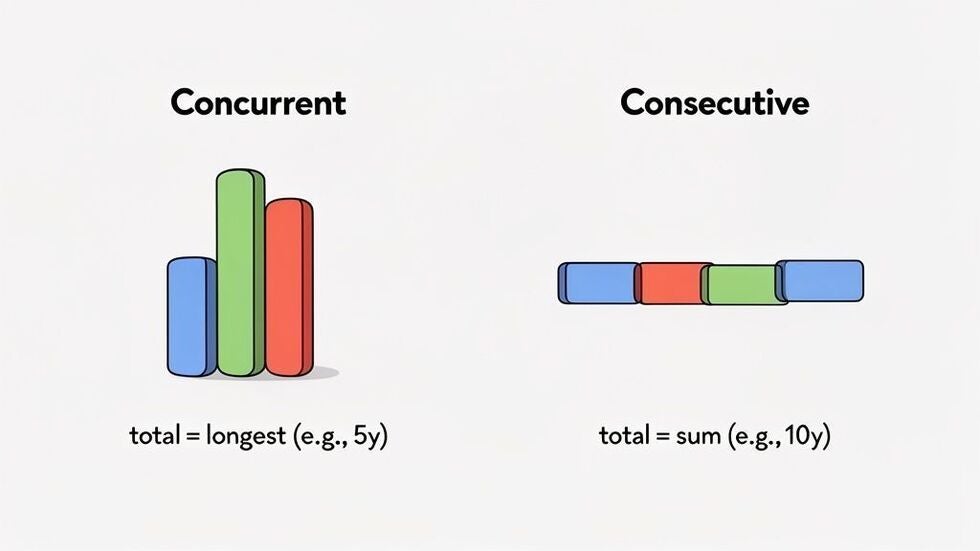
The core distinction is straightforward: concurrent sentences are served at the same time, while consecutive sentences are served one after the other.
Defining Your Sentence: Concurrent vs. Consecutive Sentences
Think of it this way. A concurrent sentence is like running multiple timers at once. If you're handed sentences of 3 years, 5 years, and 10 years to be served concurrently, they all start ticking down on day one. Your total time in prison is dictated by the longest sentence—in this case, 10 years. Once that longest timer hits zero, you're done.
A consecutive sentence, on the other hand, is like lining those timers up in a row. You have to finish the first one before the next one can even start.
Using that same example—3, 5, and 10 years—you would serve them back-to-back. The total time becomes the sum of all sentences: 3 + 5 + 10 = 18 years. A huge difference.
The choice isn't just a matter of simple math; it fundamentally alters a person's life trajectory.
As you can see, the outcome changes dramatically based on a single word from the judge.
Quick Comparison: Concurrent vs. Consecutive Sentencing
While the definitions are simple, their real-world impact is massive. A judge's decision isn't made in a vacuum; it's shaped by Indiana law, the nature of the offenses, and—crucially—the arguments made by the defense and prosecution.
This table puts the practical difference in black and white.
| Sentencing Type | How Time Is Served | Example Conviction | Total Time Served |
|---|---|---|---|
|
Concurrent |
Simultaneously, with all sentences running at once. |
Two separate Level 6 Felonies, each with a 2-year sentence. |
2 Years |
|
Consecutive |
Back-to-back, with each sentence starting after the previous one ends. |
Two separate Level 6 Felonies, each with a 2-year sentence. |
4 Years |
It's clear how quickly the time can stack up.
The key takeaway is this: concurrent sentencing defaults to the longest single sentence, while consecutive sentencing adds all individual sentences together to determine the total length of incarceration.
This is exactly why fighting for concurrent sentences is almost always a primary goal for any defense lawyer when their client is facing multiple charges in Indiana. It is one of the most effective ways to limit a person's total exposure and get them back to their life sooner.
How Indiana Law Governs Sentencing Decisions
In Indiana, the decision between concurrent and consecutive sentences isn't just a flip of a coin; it's guided by a specific legal framework spelled out in state statutes. Unlike some states with a hard and fast rule, Indiana law gives judges quite a bit of room to maneuver. But that power is reined in by strict rules that dictate when and how sentences can be stacked. If you're facing multiple criminal charges, understanding these rules is everything.
The starting point in Indiana is that sentences for multiple convictions are presumed to run concurrently. This is a critical principle. However, the law carves out specific exceptions that allow a judge to impose consecutive terms, turning what might be a five-year sentence into a ten-year term—or even longer.
The Deciding Factor: The "Single Episode of Criminal Conduct"
One of the most powerful concepts in Indiana sentencing law is the "single episode of criminal conduct." This isn't just legal jargon; it's a rule that can dramatically cap your prison time. This term refers to crimes that are so closely connected in time, place, and circumstance that they are essentially part of one continuous event.
If a court decides that multiple offenses were all part of a single episode, its power to stack sentences gets severely limited. For example, if someone robs a convenience store and shoves the clerk in the process, a judge would almost certainly see the robbery and battery as part of one event. In these situations, the total length of the consecutive sentences cannot exceed the maximum sentence for the next highest-level felony involved.
A judge can't just decide to stack sentences on a whim. They must state specific aggravating circumstances on the record to justify it. This requires a clear, evidence-based explanation rooted in the facts of the case and the defendant's history.
This "single episode" rule is a vital safeguard against ridiculously long sentences for a single bad decision. A sharp defense attorney will tear apart the facts to argue that all charges fall under one episode, putting a firm ceiling on potential prison time. You can dive deeper into the factors judges weigh in our comprehensive guide on Indiana sentencing guidelines.
Indiana vs. Federal Sentencing: A Critical Distinction
It's crucial to know that Indiana's system is a world away from the federal courts. The federal legal framework is built on entirely different policy ideas that directly impact how much time a defendant will actually serve. Under 18 U.S.C. Section 3584, the federal system essentially defaults to consecutive sentences unless a judge goes out of their way to order concurrent time. You can learn more about the complexities of the federal approach to sentencing on ussc.gov.
This creates a night-and-day legal difference. In federal court, the presumption is that sentences will be stacked, and the defense has to fight for a concurrent outcome. In Indiana's state courts, the opposite is often true—the burden is on the prosecutor to convince the judge that a harsher, consecutive sentence is justified.
Aggravating and Mitigating Factors
When a judge does have the discretion to choose between consecutive and concurrent sentences, their decision comes down to a careful weighing of aggravating and mitigating factors. These are the specific details about the crime and the defendant that can either ratchet a sentence up or bring it down.
Common factors that a judge will look at include:
- The Defendant's Criminal History: A long or violent record is a huge aggravating factor that screams for consecutive time.
- The Nature of the Offenses: Crimes that cause serious injury, target vulnerable victims like kids or the elderly, or involve a weapon are far more likely to get stacked sentences.
- Cooperation with Law Enforcement: A defendant's choice to cooperate or show genuine remorse can be a powerful mitigating factor arguing for concurrent sentences.
- Character and Personal Circumstances: Evidence of good character, community ties, or struggles with addiction or mental health can persuade a court toward leniency.
In the end, the judge's decision is a balancing act. This makes telling a compelling story about the defendant's life and the circumstances of the crime absolutely essential.
Calculating the Real-World Impact on Your Freedom
The difference between a concurrent and consecutive sentence isn't just legal theory—it's the stark reality of how many years you might spend behind bars. These abstract terms become painfully concrete when you start calculating the actual time served, revealing how a judge's decision can dramatically alter the course of your life.
Let's move from definitions to real-world math. Imagine you're convicted in Indiana of two separate Level 5 Felonies for theft, and the judge hands down a four-year sentence for each. The way these sentences are structured fundamentally changes everything.
Concurrent vs. Consecutive Calculations
The math itself is simple, but the consequences are profound. Here's a quick breakdown of how the exact same convictions can lead to wildly different amounts of time you'll actually serve.
- Concurrent Calculation: With concurrent sentences, both four-year terms run at the same time. You serve the longest single sentence. In this scenario, the math is straightforward: 4 years total.
- Consecutive Calculation: With consecutive sentences, the terms are served one after the other. The total time is the sum of all individual sentences. The calculation becomes 4 years + 4 years = 8 years total.
Just like that, the judge's decision to "stack" the sentences has doubled the prison time. This is exactly why understanding the factors that influence this choice is so critical to your defense.
This decision isn't just about punishment; it's a determination of how much of your future will be spent behind bars. A four-year difference can mean missing graduations, birthdays, and the chance to rebuild your life.
While these examples hit close to home, the impact of consecutive sentencing is felt nationwide. Recent research on California sentencing patterns found that while consecutive sentences are applied in about 22% of all prison admissions, that number skyrockets to 51% for cases involving multiple convictions. The result is a substantial increase in prison time, with the average sentence climbing from 8.6 years to 11.6 years—a three-year jump. You can explore the full findings of this study to see how consecutive sentencing is applied to criminal sentences on capolicylab.org.
More Complex Sentencing Scenarios
To show how this plays out with different charges, let's look at a more complex example. Say a person is convicted of a Level 4 Felony for Burglary (a 6-year sentence) and a Level 6 Felony for Resisting Law Enforcement (a 1-year sentence).
Here's a quick look at how the total sentence can change based on the judge's ruling.
Sentencing Calculation Scenarios
| Offense Scenario | Individual Sentences | Total Time (Concurrent) | Total Time (Consecutive) |
|---|---|---|---|
|
Two Level 5 Felonies |
4 Years & 4 Years |
4 Years |
8 Years |
|
Burglary & Resisting |
6 Years (Level 4) & 1 Year (Level 6) |
6 Years |
7 Years |
Even a one-year difference matters immensely. On top of that, the total sentence length directly impacts eligibility for good time credit and other programs. A longer sentence can push back potential parole dates and limit access to alternative sentencing options that might otherwise have been on the table.
These calculations can get even more complicated when you factor in credit for time served while your case was pending. Estimating your potential release date requires careful accounting of every single day spent in custody. To get a clearer picture of your specific situation, you can use our Indiana jail credit time calculator to help understand these crucial numbers. An accurate calculation provides a realistic baseline for what you are facing, making it an essential tool in planning your defense strategy.
Long-Term Consequences Beyond the Prison Walls
The judge's decision on consecutive vs. concurrent sentences echoes far beyond the day you stand in court. The total length of your time behind bars creates a ripple effect, one that can permanently change your life long after you're released. A longer sentence—often the direct result of stacked, consecutive terms—builds higher and more formidable barriers to successfully rejoining society.
The impact hits almost immediately. Finding a stable job is the first step toward rebuilding a life, but a lengthy criminal record tied to significant prison time is a massive red flag for employers. Many companies simply won't hire individuals with certain felony convictions, and in a hiring manager's eyes, a longer sentence often signals a more serious offense.
Barriers to Rebuilding Your Life
This challenge bleeds directly into finding a place to live. Landlords run background checks, and a record showing a decade or more of incarceration can lead to an automatic denial of your rental application. The same goes for professional licensing; careers in fields like healthcare, education, or finance often have strict character and fitness standards that can permanently disqualify someone who has served a long prison sentence.
The consequences touch nearly every part of daily life, creating a vicious cycle of exclusion:
- Employment: A longer sentence can be seen as a higher risk, shrinking the pool of available jobs to almost nothing.
- Housing: Many apartment complexes and property managers use screening policies that automatically filter out applicants with significant felony records.
- Professional Licenses: Careers that require a state license, from cosmetology to real estate, might become permanently out of reach.
A longer sentence isn't just about lost time; it's about lost opportunities. Every additional year served consecutively compounds the difficulty of securing the basic building blocks of a stable life—a job, a home, and a career.
These aren't just minor hurdles; they are life-altering obstacles. The difference between a five-year concurrent sentence and a ten-year consecutive one can be the difference between having a fighting chance and facing a future of closed doors.
Lasting Impact on Civil Rights and Freedom
Beyond the practical roadblocks, the total length of your sentence has a profound and often permanent impact on your civil liberties. In Indiana, a felony conviction means you lose your right to own or possess a firearm. This is a lifetime ban, not something that goes away once you've completed your sentence. While a longer sentence doesn't change this specific outcome, it underscores the finality of the consequences tied to the conviction.
Furthermore, the period of post-release supervision is directly tied to your sentence structure. A longer total sentence often leads to a more drawn-out and restrictive term of parole or probation. Instead of walking back into full freedom, you could spend years under the watchful eye of the criminal justice system, navigating strict rules, constant check-ins, and the ever-present threat of being sent back to prison for a minor slip-up.
The fight for a concurrent sentence, then, is also a fight for a shorter leash upon release. Fortunately, under certain conditions, it is possible to seek changes after the fact. You can learn more about how to pursue this option in our guide on sentence modifications in Indiana. It's a critical tool for those seeking a second chance.
Building a Defense Strategy for Concurrent Sentencing
When you're facing multiple criminal charges, one of the most critical battles is fighting for concurrent sentences instead of consecutive ones. While Indiana judges hold a lot of power in this decision, it's not left to chance. Their judgment is heavily shaped by the arguments your defense team presents. A sharp defense attorney doesn't just show up and hope for the best; they build a proactive, detailed strategy from day one, aimed squarely at convincing the court that concurrent sentencing is the only just outcome.
This work starts long before anyone steps into a courtroom for sentencing. It requires a deep dive into the facts of your case and your personal history to find every possible mitigating factor. The goal is to paint a full picture for the judge—one that moves beyond the black-and-white charges on paper and reveals the human being at the center of it all.
Crafting a Compelling Narrative for the Court
An effective defense strategy is all about storytelling, backed by hard evidence and solid legal arguments. We work to build a powerful narrative that hits on key legal and personal points designed to persuade a judge toward leniency.
A cornerstone of this approach is arguing that the offenses were all part of a single episode of criminal conduct. We meticulously break down the timeline, locations, and your alleged intent for each charge to show they are so closely related they should be treated as one event. If we can successfully make this case, it can legally limit the judge's ability to stack sentences one after another.
But the legal arguments are only half the battle. We also have to humanize you in the eyes of the court. This is done by presenting a wide range of mitigating evidence, such as:
- Your Personal History: A detailed look at your background, including any history of trauma, mental health challenges, or substance abuse issues that might have played a role in your actions.
- Character and Community Ties: Letters of support from family, employers, friends, and community leaders can be incredibly powerful. They show the court that you are more than your charges and have a support system ready to help you get back on track.
- Remorse and Accountability: Demonstrating genuine remorse and taking responsibility for your actions can go a long way with a judge. It shows you understand the gravity of the situation.
A sentencing hearing is more than a legal procedure; it's your chance to tell your story. A well-written sentencing memorandum lays the groundwork, but a powerful oral argument is where a skilled attorney can connect with the judge on a human level, turning dry legal points into a persuasive plea for mercy.
This entire narrative is formally presented in a sentencing memorandum filed with the court before being brought to life during oral arguments at the hearing itself.
The Power of Negotiation in Plea Agreements
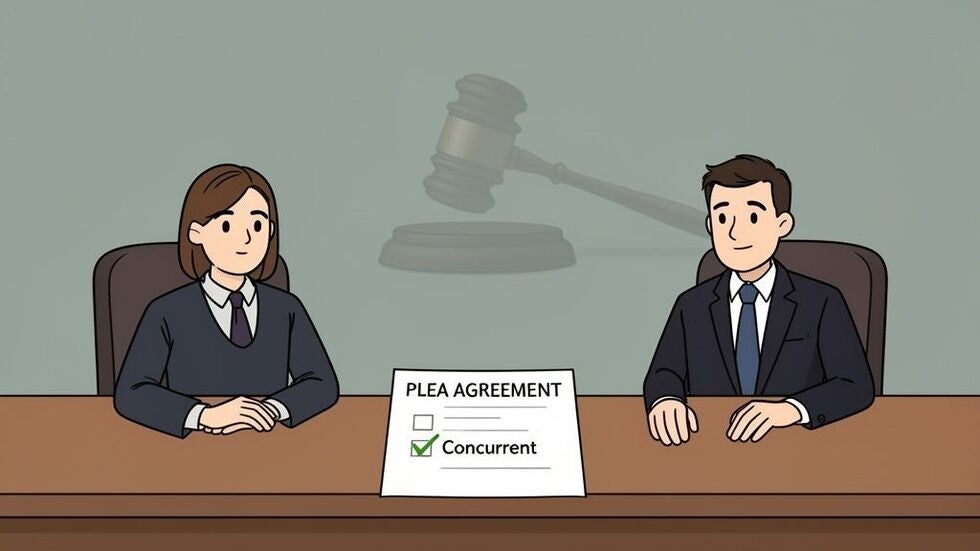
While making a strong case at sentencing is crucial, sometimes the best move is to take the decision out of the judge's hands completely. This is where skilled plea negotiations become invaluable. A proactive defense lawyer engages with the prosecutor early on, aiming to hammer out a plea agreement that specifically
guarantees concurrent sentences.
This approach gives you certainty in what can otherwise be a very unpredictable process. Instead of rolling the dice at a sentencing hearing, a negotiated plea deal can lock in a much better outcome. For example, in exchange for pleading guilty to certain charges, the prosecutor might agree that all sentences will run at the same time.
Getting a deal like this requires a deep understanding of the case's strengths and weaknesses. A defense attorney can leverage problems with the evidence, potential constitutional violations, or compelling mitigating factors to convince the prosecutor that offering a concurrent sentence is a fair compromise. This kind of strategic bargaining is often the most direct path to minimizing your total prison time and giving you a clear end date to work toward.
Ultimately, whether through courtroom advocacy or shrewd negotiation, the goal is always the same: to soften the harsh impact of the consecutive vs. concurrent sentencing decision.
Questions We Hear All the Time About Indiana Sentencing
When you're staring down multiple criminal charges in Indiana, the jargon around sentencing can feel like another language. The difference between getting consecutive vs. concurrent sentences is huge, and it brings up a lot of practical, real-world questions. Here are some straight answers to the concerns we hear most often.
Can a Plea Bargain Lock in Concurrent Sentences?
Absolutely. A plea agreement is basically a negotiated contract between your defense lawyer and the prosecutor. If your attorney can successfully negotiate concurrent sentencing as a specific term of that deal—and the judge signs off on it—it becomes a binding court order.
This is one of the most powerful tools in a defense attorney's arsenal. It yanks the unpredictability of a judge's whim out of the equation and locks in a predictable, much better outcome for your total time served. It's a perfect example of how skilled negotiation can directly control your future.
A well-negotiated plea bargain can be the difference between serving sentences back-to-back or all at once. It provides certainty in an otherwise unpredictable process.
Getting that guarantee, however, depends entirely on the strength of the negotiations and the leverage your attorney can build. Without that specific term written into an accepted plea deal, the decision goes right back into the judge's hands at a sentencing hearing.
What Happens If I'm Convicted in Different Counties?
This is where things get complicated—fast. When you have sentences handed down by courts in different counties, the default assumption is often that they will run consecutively. Each court is its own island; one judge isn't bound by another's sentencing decision.
This creates a dangerous situation where sentences can stack up automatically unless there's a coordinated legal effort to stop it. To get a concurrent sentence across multiple jurisdictions, your attorney has to pull off a much trickier legal maneuver. They must:
- Negotiate a global resolution with prosecutors from every single county involved.
- Persuade the judges in each courtroom to explicitly order their sentences to run concurrently with the sentences from the other counties.
This demands a defense lawyer who can do more than just fight in one courtroom. They need to be able to manage and coordinate multiple cases at the same time to protect your bottom line.
How Does My Prior Criminal Record Affect Sentencing?
Your criminal history is one of the biggest aggravating factors a judge has to weigh under Indiana law. It paints a picture of your past, and you can bet the prosecutor will use it to argue for a tougher penalty, including consecutive sentences. A record of prior convictions, especially for similar or violent crimes, sends a strong signal that a more severe punishment is needed.
This makes it absolutely critical for your defense to present powerful mitigating factors. Your attorney's job is to neutralize the damage of your past by highlighting evidence of rehabilitation, personal growth, strong community ties, or other circumstances that argue for a second chance. The goal is to show the judge that you are more than your past mistakes and that a concurrent sentence is the just and right outcome.
Navigating the maze of Indiana sentencing requires a deep understanding of the law and a strategic, aggressive approach. At the Law Office of Mark Nicholson, we fight to protect your future by pushing for the most favorable sentencing outcome possible. If you are facing multiple charges, contact us today for a confidential consultation at https://www.marknicholsonlaw.com/contact.


Comments
There are no comments for this post. Be the first and Add your Comment below.
Leave a Comment