
Can an Off Duty Cop Pull You Over? Get Legal Answers
A dark sedan slides up behind you at a stoplight. Blue lights flash from the dashboard. The driver is not in uniform. He walks to your window, shows a badge, and says he is a police officer.
Most drivers in that moment do not know whether they are dealing with a lawful stop, an off-duty officer acting within legal authority, or something they should challenge later in court. They are trying to stay safe, avoid making the situation worse, and figure out whether they have to comply.
That confusion is real. It matters more in Indiana because the answer is not a broad national rule about police power. Indiana has a specific statute that can make an off-duty or plainclothes traffic stop unlawful, especially when the officer is in an unmarked vehicle.
If you are asking can an off duty cop pull you over, the right answer is not a yes or no. It depends on the officer's status, the vehicle, the reason for the stop, the location, and what happened next. It also depends on whether the officer was exercising lawful authority or just claiming it.
The Unsettling Reality of a Surprise Traffic Stop
A surprising traffic stop feels different from a normal one right away. You expect a marked cruiser. You expect a uniform. You expect obvious authority.
Instead, you may see a personal vehicle with dash lights, or a plainclothes person approaching your door at a gas station or after a minor traffic dispute. That is when good judgment gets harder.
Why this situation rattles people
Many drivers ask several things at once:
- Is this a real officer: A badge flashed through a window is not much time to verify identity.
- Do I have to stop immediately: Moving to a better-lit location may be safer, but drivers worry that doing so will be treated as fleeing.
- Can an off duty cop pull you over in Indiana: That question has a different answer here than it does in many other states.
- If the stop is illegal, what should I do right now: The answer is usually not to argue roadside.
The stress gets worse if the officer starts giving commands before backup arrives.
The question behind the question
People rarely mean only one thing when they ask this. They usually mean one of three things.
They want to know whether the officer has legal power to detain them. They want to know whether they can refuse roadside demands. And they want to know whether an arrest or charge can be beaten later because the stop itself was improper.
Key point: Your roadside goal is safety. Your courtroom goal is legality. Those are not always handled the same way.
Indiana drivers need both pieces. You need enough calm, practical guidance to get through the encounter without escalating it. And you need to understand when a questionable stop can become a strong suppression issue, a dismissal issue, or even a civil rights case.
The Legal Authority of an Off-Duty Officer
Police authority does not always begin and end with a scheduled shift. In many places, courts treat officers as carrying police authority even when they are off the clock, especially when they claim that authority in public.
A simple analogy helps. A doctor does not stop being a doctor when leaving the hospital. A police officer does not necessarily stop being a police officer when driving home. But that does not mean every off-duty action is lawful, wise, or protected.
Acting under color of law
The legal phrase is under color of law. It matters because an off-duty officer who uses police authority can still be treated as acting officially.
That is one reason off-duty conduct creates risk not for the officer, but for the city or department. A legal reading on off-duty police ethics and liability discusses Birmingham v. Benson, where a $1.6 million judgment held a municipality liable when an off-duty officer acted in an official capacity during traffic-related enforcement. The same material states that 67% of major U.S. police departments adopted specific off-duty protocols to limit liability, especially in traffic enforcement.
That tells you something important. Departments know this area is dangerous. They know off-duty enforcement can expose everyone involved to legal consequences.
Authority exists, but it is not unlimited
The broad rule is that off-duty officers may still intervene in some circumstances. That is why a stop is not automatically invalid because the officer was off shift.
But three limits matter:
Factor Why it matters How the officer identified themselves A claimed badge and verbal command may not be enough for every kind of stop What the officer was trying to enforce Serious observed conduct is treated differently from a routine traffic infraction What state law and department policy require These rules often narrow what an off-duty officer may do in practice Many drivers assume the issue is only constitutional. It is not. State statutes and agency rules often decide whether the stop was proper.
Liability and immunity are different questions
An officer may claim they had authority. A court may later decide the officer exceeded it. That is where criminal defense and civil rights law start to overlap.
If you want a plain-English overview of how officials try to avoid personal liability, this discussion of qualified immunity and whether it should be reformed helps frame the bigger issue.
Practical takeaway: Off-duty authority is real, but it is conditional. The strongest cases turn on the details the officer thought did not matter.
Those details include the car, the uniform, the location, what the officer claimed to observe, whether backup arrived, and whether your detention fit Indiana law.
Indiana Law A Significant Distinction for Motorists
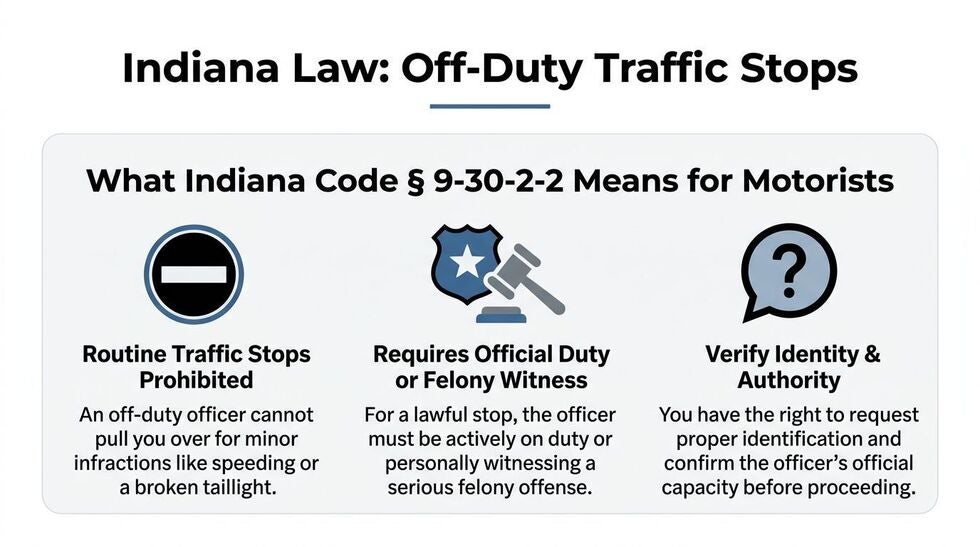
Indiana gives drivers a powerful issue that many national articles either blur or miss. Indiana Code § 9-30-2-2 explicitly states that an officer in an unmarked vehicle who is not in uniform lacks the authority to stop and cite a driver for a traffic violation. That point is discussed in this Indiana-focused analysis of whether an off-duty officer can give a ticket.
That is not a minor technicality. It can change the entire case.
What the statute means in plain English
If an officer is:
- Not in uniform
- In an unmarked vehicle
- Trying to stop and cite you for a traffic violation
Indiana law creates a serious problem for the stop.
That matters in real cases involving speeding, lane movement, equipment issues, and the kind of minor traffic allegations that often become the gateway to something bigger. Once the stop happens, the officer may claim to smell alcohol, ask questions, order field sobriety testing, or search further. If the initial detention was unlawful, the entire prosecution can become vulnerable.
Why this matters so much in OVWI and drug cases
A traffic stop is often the first link in the chain. If the first link breaks, everything after it may be excluded.
That is why can an off duty cop pull you over is not a curiosity question. In Indiana, it can become a suppression question. And suppression often matters most in cases involving:
- OVWI or DUI allegations
- Drug possession charges
- Gun cases arising from vehicle searches
- Resisting allegations tied to the stop itself
A quick way to think about it
Use this comparison:
Situation Likely legal concern in Indiana Plainclothes officer in unmarked car stopping you for speeding Strong challenge under IC § 9-30-2-2 Uniformed officer in properly identified police vehicle Different analysis, not the same statutory problem Off-duty officer observing something serious and summoning on-duty backup Often safer legally for the officer than conducting full roadside enforcement alone The practical lesson is that Indiana separates routine traffic enforcement from broad, free-floating police authority more sharply than many drivers realize.
What does not work
Drivers often hurt their case by focusing on the wrong point.
These arguments go nowhere by themselves:
- “He was off duty, so everything is void.” Off-duty status alone is not enough.
- “He showed a badge, so the stop had to be lawful.” Claimed authority is not the same as lawful authority.
- “If I was guilty of something else, I cannot challenge the stop.” Wrong. Illegal stops can still be challenged even when police later discover incriminating evidence.
What does work
A serious defense looks closely at the facts:
- Was the vehicle marked or unmarked
- Was the officer in uniform
- What exact traffic basis was asserted
- What body cam, dash cam, dispatch, and CAD records show
- Whether the stop turned into questioning or searches that flowed from the initial detention
Important: In Indiana, the stop itself can be the defense. If the officer lacked authority to make it, later evidence may not survive a suppression challenge.
That is the distinction many people miss. The issue is not whether police eventually found evidence. The issue is whether they got to that evidence lawfully.
Common Scenarios and How to Identify a Lawful Stop
Drivers usually do not encounter this issue in a law-school hypothetical. They encounter it in a parking lot, on a county road at night, or after a tense exchange in traffic.
The best way to answer can an off duty cop pull you over is to look at how these situations unfold.
Scenario one at a gas station
You pull into a gas station after someone behind you has been tailgating. A man in plain clothes gets out, flashes a badge, and starts accusing you of reckless driving.
He may be a real officer. He may also be outside the kind of formal traffic stop Indiana law expects for routine traffic enforcement. If he starts ordering you to stay put, give identification, or submit to questioning, the details matter fast.
Red flags include:
- No uniform
- No marked vehicle
- No clear backup request
- Escalation from a personal traffic dispute into commands
People make mistakes by arguing on the spot. Safer practice is to stay in a public, visible place, keep the interaction calm, and call 911 to verify the person's identity.
Scenario two with dashboard lights in a personal car
A personal vehicle behind you activates emergency-style lights. That does not automatically mean the stop is lawful.
Equipment and jurisdiction matter. A Justia discussion of off-duty officer authority and limits notes that without emergency lights meeting federal visibility standards, an off-duty officer cannot legally initiate a high-speed pursuit. The same source states authority often ends at jurisdictional lines unless there is fresh pursuit, and that failure to meet that standard leads to dismissal rates as high as 25% in traffic courts.
That does not mean every use of lights is invalid. It means the lights alone do not settle the issue.
Scenario three with a uniformed officer in a personal vehicle
This is the trickiest scenario because it looks more legitimate. A uniformed officer driving home may still observe conduct and take action.
The legal analysis changes because one problem from the prior section may disappear. If the officer is in uniform, the statutory challenge may look different than it does with a plainclothes officer in an unmarked car.
A practical checklist for drivers
If you are unsure whether the stop is lawful, look for these indicators without escalating:
- Vehicle clues: marked cruiser, agency decals, standard emergency equipment
- Officer clues: uniform, badge, department name, radio traffic
- Scene clues: backup en route, dispatch confirmation, location within jurisdiction
If you have questions about checkpoint-style vehicle seizures and how courts analyze them differently, this guide on DUI checkpoints and your rights gives useful contrast.
Rule of thumb: The more the encounter looks like private improvisation instead of standard police procedure, the more likely it deserves a hard legal review later.
Your Rights and What to Do During an Off-Duty Stop
When the lights come on, you are making two decisions at once. You are deciding how to stay safe now, and how to preserve a challenge for later.
The second goal never justifies risking the first.
First moves that protect you
If the vehicle behind you is unmarked or the officer appears off duty, do not slam on the brakes or jump out of the car. Slow down, signal, and move to a safe, populated, well-lit area if one is nearby.
Then do the basics:
- Keep your hands visible.
- Roll the window down enough to speak clearly.
- Turn on interior lighting if it is dark.
- Call 911 if you need to verify that the person is an officer.
Many jurisdictions broadly interpret police authority. In a WCNC video discussion referencing North Carolina v. Gaines, the rule is described as “there is no distinction between on duty and off duty” in that jurisdiction, and the practical advice is to comply during the stop and challenge legality later to avoid extra charges like resisting arrest. That discussion appears in this video about off-duty police authority. Indiana has more specific statutory protections, but the safety lesson still applies.
What to say and what not to say
You do not need to argue roadside about the statute. You do not need to educate the officer on Indiana law through your window.
Use simple language.
Good examples:
- “Officer, I want to comply safely.”
- “Please identify your department.”
- “I am not consenting to any searches.”
- “I would like to remain silent.”
Bad examples include sarcasm, legal speeches, accusations, and any sudden refusal to follow basic commands that could trigger a resisting allegation.
Recording the encounter
If you can do it safely, start recording. Keep the phone where it does not look like a weapon and do not hide what you are doing.
What you want to capture:
- The vehicle itself
- The officer's clothing
- The badge and name if visible
- Statements about why you were stopped
- Any claim about being off duty or heading home
- Whether backup arrives and from where
That footage can matter later when the officer's report smooths out inconvenient details.
Preserve the right issues
Do not volunteer facts that help build the state's case.
That means avoiding statements like:
- “I only had a couple drinks.”
- “I know I was speeding.”
- “The gun is in the console.”
There is a difference between identifying yourself and helping prosecute yourself.
A short reminder on roadside conduct can help:
A practical roadside sequence
Here is the sequence that works best:
Step What to do Seeing lights Slow down and move to a safer visible location Initial contact Stay calm, keep hands visible, ask for identification If uncertain Call 911 and say you are trying to verify the stop Questioning Provide required identifying documents, then limit statements Search requests Clearly say you do not consent Afterward Write down everything as soon as you can Practical tip: Compliance and consent are not the same thing. You can comply physically while still refusing permission for a search and preserving your objection.
What works best after the stop ends
As soon as you are safe:
- Write down the time and place
- Describe the car
- Describe the officer's clothing
- Save your phone video
- Screenshot call logs if you contacted 911
- Keep any ticket, warning, or paperwork
- List witnesses immediately
Memory fades fast. Reports do not.
Challenging an Unlawful Stop Defenses That Work
An unlawful stop is not something to complain about. It is often the strongest defense in the case.
In criminal court, the key question becomes whether the seizure violated the Fourth Amendment or Indiana law. If it did, the defense usually attacks everything that came after.
The suppression issue
The usual tool is a motion to suppress evidence. The argument is straightforward.
If police had no lawful basis to stop you, then the state should not get to use the products of that stop against you. That may include:
- Your statements
- Field sobriety results
- Chemical test issues tied to the detention
- Contraband found during a search
- Observations made only because the stop occurred
The phrase fruit of the poisonous tree applies. If the tree is poisoned, the fruit can be excluded.
How the facts become a defense
Strong suppression litigation is detail work. The defense looks for inconsistency between the report and reality.
Useful evidence often includes:
Evidence What it can prove Dash cam and body cam Whether the vehicle was marked, when commands began, and how the stop developed Dispatch records Whether the stop was called in promptly and how the officer described the event CAD logs Timing, backup, jurisdiction, and whether standard procedure was followed Civilian video The appearance of the car, the officer, and your location Officer testimony Gaps, contradictions, and admissions about being off duty In Indiana, if the stop came from an officer who was not in uniform and was in an unmarked vehicle enforcing a traffic matter, that statutory issue can drive the whole motion.
When the case becomes a civil rights case too
Some encounters go beyond suppression. They involve force, intimidation, or an officer using claimed police authority during what would otherwise be a private confrontation.
A legal bulletin discussing Anderson v. Warner explains that an off-duty officer acted under color of law when he invoked police authority during a private dispute. The same bulletin states that off-duty incidents make up 12% of all police use-of-force complaints, with 28% involving traffic encounters. That discussion appears in this AELE analysis of off-duty officer liability and Anderson v. Warner.
That matters because some cases are not about beating the charge. They are about suing over the stop, the detention, the force used, or the humiliation inflicted.
If you are dealing with that side of the problem, this guide on understanding police misconduct and filing a complaint effectively is a useful starting point.
Bottom line: A bad stop can break the prosecution's case. A violent or abusive stop can also create a separate civil rights claim.
What usually fails
These arguments are weaker than people think:
- General outrage without documentation
- Admitting too much before hiring counsel
- Assuming the judge will infer the illegality without records
- Focusing on the officer being off duty instead of the specific statutory defect
The winning approach is narrower and sharper. Show exactly why the officer lacked authority. Tie that defect to the seizure. Then tie the seizure to the evidence the state wants to use.
When You Need to Call an Indiana Defense Attorney
You should call an attorney quickly if any off-duty stop led to an arrest, an OVWI allegation, a vehicle search, a gun charge, a drug charge, or any use of force.
You should also call if the facts sound wrong on paper. That includes a plainclothes officer in an unmarked vehicle, a stop outside normal jurisdiction, or a report that leaves out how the encounter really began.
The biggest takeaways
Indiana drivers should remember three things.
First, can an off duty cop pull you over is not answered by a broad national rule alone. Indiana has a specific statute that can make certain traffic stops unlawful.
Second, roadside safety and courtroom strategy are different. Comply carefully. Do not consent unnecessarily. Preserve evidence.
Third, unlawful stops are not small technical errors. They can become the central defense to the charge and, in some situations, the basis for a civil rights claim.
Situations that deserve immediate review
Do not wait if any of these happened:
- You were arrested after a stop by a plainclothes officer
- The officer was in an unmarked vehicle
- You were accused of OVWI after a questionable initial stop
- The officer searched your car
- The officer used force or threatened force
- The event started as a personal traffic dispute and turned into police commands
Good defense work starts early because video disappears, memories change, and official narratives harden fast.
The legal issue may not be whether you committed the later offense the state is focused on. The legal issue may be whether the state had any right to put you in that position in the first place.
If you were stopped, arrested, or injured after a questionable traffic encounter, the Law Office of Mark Nicholson handles Indiana criminal defense and civil rights cases involving unlawful stops, excessive force, and police misconduct. A fast case review can identify whether Indiana's unmarked-vehicle rule, a suppression motion, or a civil rights claim may apply.
| Factor | Why it matters |
|---|---|
|
How the officer identified themselves |
A claimed badge and verbal command may not be enough for every kind of stop |
|
What the officer was trying to enforce |
Serious observed conduct is treated differently from a routine traffic infraction |
|
What state law and department policy require |
These rules often narrow what an off-duty officer may do in practice |


Comments
There are no comments for this post. Be the first and Add your Comment below.
Leave a Comment