
What Happens at Arraignment Hearing: A Quick Guide
Your First Court Date: What Is an Arraignment?
Stepping into a courtroom for the first time can feel like entering a foreign country where you don't speak the language. The arraignment hearing is the very beginning of this journey. It's a brief but fundamentally important procedural checkpoint.
The purpose here is administrative, not evidentiary. You won't see witnesses testifying or evidence being presented to prove the case. The court is focused on three core objectives to get the case officially underway.
Key Goals of the Arraignment
This initial hearing isn't just a formality; it serves critical functions that protect your rights and sets the timeline for the rest of your case. An arraignment represents your first formal appearance in court, where you're officially informed of the charges against you and given the opportunity to enter a plea.
During this proceeding, a judge or prosecutor will read the criminal charges aloud, ensuring you understand exactly what crimes the state is accusing you of committing. You can discover more insights about this crucial first step into the legal system by exploring what happens at an arraignment hearing.
The whole process is built around ensuring clarity and due process from the very start.
- Formal Notice of Charges: The court officially tells you the specific criminal charges the prosecution has filed. This isn't a vague summary; it's the formal accusation you'll be facing.
- Advisement of Rights: The judge will explain your fundamental constitutional rights, including the right to an attorney, the right to a speedy trial, and the right to remain silent.
- Entering a Plea: You will be asked to enter an initial plea to the charges. The standard—and almost always most strategic—plea at this stage is "not guilty."
Think of the arraignment as the legal system's way of saying, "Here is what the state is accusing you of, here are your rights, and here is your first chance to respond." Pleading "not guilty" doesn't mean you're denying everything; it's a procedural move that preserves all your legal options while your attorney investigates the case.
Finally, another crucial issue often addressed during this hearing is your pre-trial release. The judge will review or set bail conditions, determining whether you will be released from custody while the case proceeds and under what specific terms. This decision is based on factors like the severity of the charge, your criminal history, and your ties to the community.
To help you visualize the flow of events, here's a simple breakdown of what to expect.
| Event | What It Means for You | Why It Happens |
|---|---|---|
|
Case is Called |
Your name will be called, and you (and your attorney) will approach the front of the courtroom. |
This officially begins your hearing before the judge. |
|
Charges are Read |
The judge or prosecutor will read the formal charges filed against you. |
This ensures you are officially aware of the exact accusations. |
|
Rights are Advised |
The judge will list your constitutional rights, like the right to an attorney and to remain silent. |
This is a fundamental due process protection to make sure you know your legal safeguards. |
|
Plea is Entered |
You will be asked to plead "guilty," "not guilty," or "no contest." |
Your plea is your formal response to the charges. Pleading "not guilty" is standard practice. |
|
Bail/Release is Set |
The judge will decide on bail amount and conditions for your release while the case is ongoing. |
This determines if you remain in custody or are released, based on flight risk and public safety. |
|
Next Court Date is Set |
The judge will schedule your next hearing, which is often a pre-trial conference. |
This establishes the legal timeline and keeps the case moving forward. |
This hearing moves quickly, but each step is a critical building block for your defense. Understanding the sequence helps demystify the process and allows you and your attorney to be fully prepared.
Who Is in the Courtroom During an Arraignment
Walking into a courtroom for the first time can feel intimidating, like you've stumbled onto a movie set where everyone knows their lines but you. But understanding who's who and what they do can turn that confusion into confidence. Let's break down the key players you'll see at your arraignment hearing so you know exactly what's happening around you.
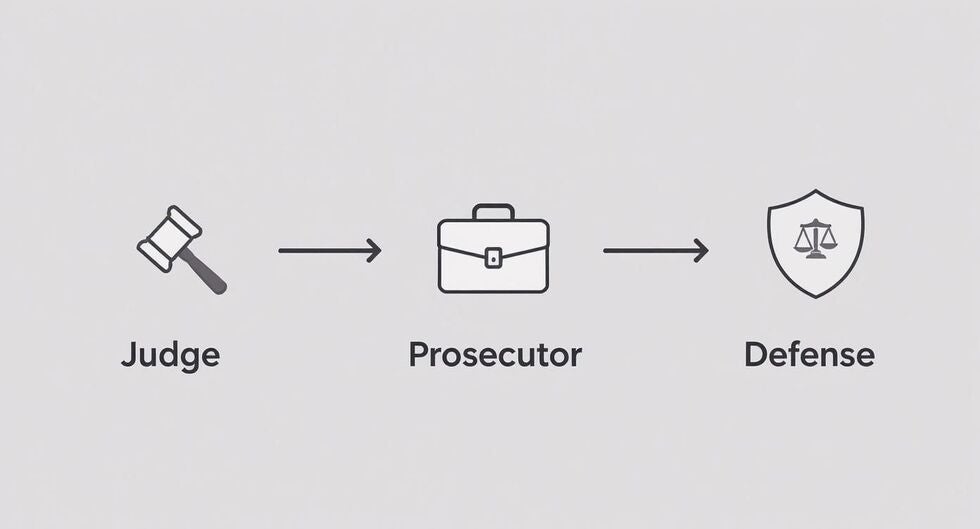
The person running the show is the Judge. They sit at the front of the room, usually on a raised platform called the bench. Think of the judge as the referee of the courtroom—their job is to make sure all the rules are followed, inform you of your rights, decide on bail, and keep everything orderly and on track.
You'll also see the Prosecutor, who might be called the Deputy Prosecutor or D.A. (District Attorney). This is the lawyer representing the government—the State of Indiana—in the case against you. Their goal is to prove the charges, and they are your legal opponent in this process.
Your Advocate and the Courtroom Staff
The most important person on your side is your Defense Attorney. This is your guide, your strategist, and your voice in the courtroom. Their only job is to protect your rights, challenge the state's case, and give you the best legal advice possible. From this point forward, they do the talking for you.
An arraignment isn't a casual chat between you and the judge. It's a formal legal event where your defense attorney speaks on your behalf to make sure every action taken is in your best interest.
Beyond these main players, a few other people are essential to keeping the court running smoothly.
- The Bailiff: This is the uniformed officer, often a sheriff's deputy, who provides security. They keep order in the courtroom, escort defendants, and make sure everyone stays safe.
- The Court Clerk: Usually sitting near the judge, the clerk is the official record-keeper. They handle all the case files, document the judge's orders, and swear people in before they speak.
- The Court Reporter: This person creates a word-for-word transcript of everything said during the hearing, either by typing on a special machine or using recording equipment. Their record becomes the official account of what happened.
Once you can identify these key figures and understand their roles, the courtroom becomes a much less mysterious place, allowing you to focus on what matters most: your defense.
The Arraignment Hearing Process Step by Step
Walking into a courtroom for an arraignment can be incredibly intimidating, but knowing what's coming can make a world of difference. Think of it less like a trial and more like a highly structured administrative meeting. It has a clear, predictable agenda, and every step is there for a specific legal reason.
This first formal hearing is all about moving your case from the arrest phase into the proper court process. It's where the judge, the prosecutor, and your defense attorney all get on the same page.
The Formal Reading of the Charges
The hearing kicks off when the court formally reads the charges filed against you. This isn't just a quick summary; the judge or clerk will state the exact criminal statutes the prosecutor claims you violated. The point is to make sure there is absolutely no confusion about the accusations you're facing.
Your defense attorney will be right there with you, and you aren't expected to say anything in response. This step is purely about getting the official charges on the court record.
Advisement of Your Constitutional Rights
Next up is one of the most important duties the judge has: the advisement of rights. This is a cornerstone of due process in our legal system. The judge will make sure you understand the fundamental constitutional protections you have.
These rights always include:
- The Right to Remain Silent: The judge will remind you that you can't be forced to say anything that might incriminate you.
- The Right to an Attorney: You have a right to legal representation. If you can't afford a lawyer, the court will appoint one for you.
- The Right to a Trial: You have the right to have your case decided by a jury of your peers or by a judge.
This formal reading ensures every single defendant knows their legal safeguards before the case moves another inch forward.
Your arraignment is not a trial. It is a procedural hearing where the groundwork is laid for your defense. The most important decisions made here are about preserving your rights and preparing for the legal journey ahead.
Entering Your Initial Plea
The main event of the arraignment is entering your plea. The judge will ask you directly how you plead to the charges. While you have a few options, one of them is almost always the right strategic move at this early stage.
There are three pleas you can enter:
- Guilty: This is an admission of guilt. It essentially ends the case and moves it directly to the sentencing phase.
- No Contest (Nolo Contendere): You accept the conviction without formally admitting you did anything wrong.
- Not Guilty: This is the standard, and highly recommended, plea at an arraignment.
Pleading "not guilty" is not about denying the facts of what happened. It's a procedural step that's absolutely necessary to protect yourself. It formally activates all your constitutional rights, especially the right to see the prosecutor's evidence (a process called "discovery"), and it gives your attorney the time needed to build a real defense strategy. Entering this plea keeps every single one of your legal options open.
It might surprise you to learn that the vast majority of criminal cases end in a plea agreement, not a dramatic courtroom trial. In 2018, only 2% of federal criminal defendants actually went to trial, while a staggering 90% of cases were resolved with a guilty plea. You can dig into these criminal justice trends from the Pew Research Center. Pleading "not guilty" at your arraignment is the critical first step that opens the door to those negotiations.
Understanding Bail and Pre-Trial Release
For most people sitting in court at an arraignment, there's one burning question that drowns out all the others: "Am I going home today?" This is where the critical concepts of bail and pre-trial release come into play. It's a common mistake to think of bail as some kind of punishment or fine. It isn't.
Think of bail more like a security deposit with the court. It's a financial guarantee you provide to ensure you'll show up for all your future court dates. At this point, the judge's main job is to figure out if you can be trusted to come back for your next hearing without being kept in jail.
How Judges Decide Your Release
A judge doesn't just pull a number out of thin air when setting bail. It's a calculated decision based on a careful look at your specific situation and the charges you're facing. They're weighing the risk you might skip town against any potential danger to the community.
Here's what the judge is looking at:
- The Nature of the Charges: More serious or violent offenses almost always mean higher bail amounts—or even no bail at all.
- Your Criminal History: A track record of past convictions is one thing, but a history of blowing off court dates is a major red flag for any judge.
- Ties to the Community: Do you have a steady job? Family nearby? Lived in the area for a long time? These connections tell the judge you're less likely to flee.
- Public Safety Concerns: The judge has to consider whether letting you out poses a threat to anyone, including the alleged victim or the community as a whole.
After weighing all these factors, the court will make a ruling that determines your freedom until your case is resolved.
Potential Outcomes for Pre-Trial Release
The judge's decision will boil down to one of three main outcomes, each with very different consequences for you. For a deeper dive into the mechanics of this process, check out our guide on how to post bail in Indiana.
Here are the possibilities:
- Released on Own Recognizance (OR): This is the best-case scenario. The judge trusts you enough to release you on your written promise to return, no money down.
- Bail is Set: The judge sets a specific dollar amount for your release. You can either pay the full amount directly to the court or, more commonly, hire a bail bond agent to post it for you for a fee.
- Bail is Denied: In the most serious cases—like murder—a judge can deny bail entirely. This means you'll remain in custody until your case is over.
The issue of pre-trial detention is a significant one. The United States holds the world's largest number of pre-trial detainees, with around 434,600 individuals held in custody before their cases are resolved. This reflects a global trend of a growing pre-trial detention population, underscoring the importance of the bail decision at your arraignment hearing. You can find more details in this global report on pre-trial detention.
Even if you are released, it usually comes with strings attached. The judge can impose specific pre-trial conditions—rules you absolutely must follow to stay out of jail. These might include no-contact orders, travel restrictions, or random drug testing. If you violate any of these conditions, your bail can be revoked, and you'll find yourself right back behind bars.
How to Prepare for Your Arraignment Hearing
Walking into a courtroom can be incredibly intimidating. The good news is that confidence often comes from knowing what to do and how to act. Taking the time to prepare for your arraignment hearing not only eases your own stress but also shows the court you're taking this matter seriously.
Think of it as preparing for any other important event. You wouldn't show up disorganized, and the courtroom is no different. Start with the basics: have your court notice (which includes your case number), a valid photo ID like a driver's license, and any documents your lawyer has given you. Keep it simple and organized.
What to Wear and How to Act
First impressions matter, especially in a courtroom. While you don't necessarily need a full suit, your attire sends a message. The best approach is business casual. Think of it like a job interview—you want to look clean, professional, and respectful. Steer clear of shorts, t-shirts with graphics, or sandals.
Your behavior in the courtroom is just as crucial. It all boils down to respect for the judge and the process.
- Arrive Early: Things always take longer than you expect. Plan to be there at least 30 minutes before your hearing is scheduled. This gives you time to get through security, find the right courtroom, and settle in without feeling rushed.
- Address the Judge Properly: When speaking to the judge, always use the title "Your Honor." It's a simple, non-negotiable rule of courtroom etiquette.
- Speak Clearly and Respectfully: If you're asked a question, stand up to speak. Make sure your voice is clear and your answers are direct. Most importantly, never interrupt anyone, especially the judge.
Your main job at the arraignment is to listen carefully and let your attorney take the lead. They will do almost all the talking. Your quiet, respectful presence backs up their legal strategy by showing the court you are a cooperative and responsible person.
By far, the most critical step you can take is hiring legal counsel before this first court date. For more insight, our article on what you need to know before hiring a criminal defense attorney can help you make a smart choice. Having an experienced lawyer by your side from the very beginning ensures your rights are protected from day one.
Navigating the Indiana Arraignment Process
While the core ideas of an arraignment are pretty much the same everywhere, the specific rules and timelines here in Indiana can make a world of difference in your case. Getting a handle on these local procedures isn't just a good idea—it's absolutely essential to protect your rights from the moment you first set foot in that courtroom.
In Indiana, the clock starts ticking the second you're in custody. An arraignment—which we often call an initial hearing—generally has to happen within 48 hours, not counting weekends and holidays. That tight timeline is exactly why you need experienced legal help, fast. An attorney who knows the local courts can move quickly, making sure you don't miss any critical deadlines or accidentally give up your rights.
Why Local Expertise Is Crucial
Every county in Indiana does things a little differently. They have their own way of managing dockets, their own pre-trial services, and their own unwritten rules. An attorney who is in these courts day in and day out knows the landscape. They know the key players, from the prosecutors to the judges, and that inside knowledge is a huge advantage when it's time to argue for a reasonable bail or start negotiations.
It also means your lawyer is deeply familiar with state-specific legal protections. For example, they'll know all the ins and outs of a Pirtle Advisement in Indiana, which is a critical warning police must give you about your rights during a vehicle search.
Having an attorney who knows the Indiana legal landscape is like having a local guide in an unfamiliar city. They know the shortcuts, the potential roadblocks, and the best route to take to protect your interests effectively from the very beginning.
At the Law Office of Mark Nicholson, guiding clients through Indiana's unique court system is what we do. We make sure that from your initial hearing forward, your defense is built on a solid foundation, designed specifically for the laws and procedures that will decide your case. A proactive approach right from the start is the key to building a strong, effective defense strategy.
Common Questions About Arraignment Hearings
When you're walking into a courtroom for the first time, it's natural to have a million questions running through your mind. Most of our clients are feeling some uncertainty about what's going to happen. Let's tackle some of the most common questions head-on with clear, straightforward answers.
Can My Case Be Dismissed at the Arraignment?
It's the question everyone wants to ask: can this all just be over right now? While it's technically possible for a prosecutor to drop the charges at this early stage, you need to understand this is extremely rare. The whole point of an arraignment is to get the legal process started, not to end it.
A dismissal at arraignment would only happen if the prosecutor suddenly discovers a massive, fatal flaw in their case, like realizing they have zero actual evidence. Don't count on it. Pleading "not guilty" is the strategic move that gives your attorney the time and legal standing to formally challenge the prosecutor's evidence and start fighting for a dismissal down the road.
What Happens If I Miss My Arraignment Hearing?
Missing your arraignment is one of the biggest mistakes you can possibly make. This is a mandatory court appearance. If you just don't show up, the judge will almost certainly issue a bench warrant for your arrest.
What does that mean? It means the next time you have any interaction with a police officer—even for a simple traffic ticket—you'll be arrested on the spot.
A bench warrant throws a huge wrench into your case. Not only does it get you arrested, but it also signals to the court that you might be a flight risk. That makes it much, much harder for your attorney to argue for favorable bail or release conditions later on.
If you have a legitimate, unavoidable conflict with your court date, you have to call your attorney immediately. They might be able to get the hearing rescheduled. Simply ignoring a court summons is never an option.
Do I Have to Speak at My Arraignment?
You'll actually say very little. Your main job is to be present, be respectful, and let your attorney do the talking. You will likely need to state your name for the record and confirm that you understand the rights the judge is reading to you.
When the time comes to enter a plea, your lawyer will almost always step in and enter the "not guilty" plea on your behalf. The court just needs to see that you're present and aware of what's happening. Your attorney is there specifically to handle the legal jargon and strategic decisions, protecting you from accidentally saying something that could damage your case.
How Long Does an Arraignment Hearing Usually Take?
The hearing itself is surprisingly fast. While you might spend a couple of hours at the courthouse waiting for your name to be called, the time you're actually in front of the judge is often just a few minutes.
The court has a long list of cases to get through for the day, which is called a docket, and they move through it at a brisk pace. Once it's your turn, the process of reading the charges, advising you of your rights, and entering your plea is quick and procedural.
Facing an arraignment can feel overwhelming, but you don't have to face it by yourself. The experienced legal team at the Law Office of Mark Nicholson is ready to protect your rights and guide you through every step of this process. Contact us today for a consultation at https://www.marknicholsonlaw.com.


Comments
There are no comments for this post. Be the first and Add your Comment below.
Leave a Comment