

You're in Indiana, and someone has died. Perhaps the incident began as a bar fight, a domestic confrontation, a road-rage encounter, or a split-second decision involving a firearm. The police may already be describing the event as a homicide, while the prosecutor is deciding whether the evidence supports murder, manslaughter, reckless homicide, or no criminal charge at all.
That decision will shape nearly everything that follows. It affects pretrial detention, plea negotiations, trial preparation, sentencing exposure, and the evidence your defense lawyer must challenge immediately. The difference between manslaughter vs murder is not merely a matter of vocabulary. It usually turns on what the State can prove about your mental state, the circumstances of the confrontation, and the connection between your conduct and the death.
Why the Manslaughter vs Murder Line Matters in Real Cases
A late-night fight outside an Indianapolis bar can produce dramatically different legal theories. Suppose two people argue, one person shoves the other, and a single punch causes a fatal fall. The prosecutor may view the punch as a reckless act, a sudden violent response, or part of a deliberate effort to kill. The physical result is the same, but the charge depends on how the State interprets the conduct and what the evidence supports.
A murder theory requires the State to present the killing as intentional, knowing, or sufficiently reckless under the governing law. A manslaughter theory presents the death as unlawful but less blameworthy, perhaps because the defendant acted in sudden heat, with criminal negligence, or during misconduct that didn't establish the mental state required for murder. The FBI offense definitions similarly distinguish willful killing from killing through gross negligence, while separating both from ordinary accidental deaths.
The charge controls the leverage
The difference affects more than the eventual sentence. A murder filing gives prosecutors a significant advantage in bond litigation and plea discussions. It also changes the defense budget, the need for forensic experts, the investigation of digital evidence, and the urgency of preserving witnesses who may disappear or change their accounts.
A manslaughter charge isn't automatically manageable. It can still mean years in prison, immediate incarceration, and lasting consequences for employment, housing, family relationships, and immigration status. But the reduced culpability theory may open negotiation and trial strategies that aren't available when the State's evidence supports planning, malice, or a deliberate killing.
Practical rule: The defense must address the mental-state evidence before the prosecutor's first charging theory hardens.
The key question is rarely just, “Did the defendant cause the death?” In many cases, everyone agrees on the physical act. The fight concerns whether the conduct proves intent, malice, conscious disregard, sudden heat, criminal negligence, lawful self-defense, or an accident. Small facts at the scene can move a case from a homicide charge carrying decades of exposure toward a lesser offense, or from a claimed accident toward murder.
What Murder and Manslaughter Actually Mean in Law
The central legal divide is mens rea, meaning the defendant's required mental state. The State must prove every element beyond a reasonable doubt. The act that caused death matters, but the defendant's state of mind often determines whether the law treats that act as murder or manslaughter.
Murder focuses on heightened culpability
Murder generally describes an unlawful killing committed with malice aforethought or an equivalent intent-based mental state. In practical terms, prosecutors look for proof that the defendant intended to kill, knew death was practically certain, or acted with an extreme disregard for human life under the applicable statute.
“Malice” doesn't require a defendant to announce an intention to kill. Prosecutors may ask a jury to infer it from statements, threats, planning, weapon use, repeated attacks, conduct after the first injury, or other surrounding facts. A person who deliberately shoots at another person's vital area may face a murder theory even if the defense argues that the person hoped the victim would survive.
The prosecution must still prove the required mental state. Anger alone isn't murder. A tragic result alone isn't murder. Nor does every reckless act automatically establish the level of culpability required for a murder conviction.
Manslaughter covers reduced culpability
Manslaughter generally involves an unlawful killing without the malice or intent associated with murder. Voluntary manslaughter typically involves a killing during sudden heat of passion after legally adequate provocation. The defense must examine what happened immediately before the killing, how quickly events unfolded, whether the defendant had time to cool off, and whether the alleged provocation satisfies the jurisdiction's legal standard.
Involuntary manslaughter generally involves an unintentional death caused by criminal negligence, gross negligence, recklessness, or certain unlawful conduct that doesn't rise to the level of a felony. Ordinary carelessness usually isn't enough. The State must connect the defendant's conduct to a sufficiently serious disregard for safety.
The Congressional Research Service summary of federal homicide penalties illustrates why this classification carries practical weight. Under federal law, first-degree murder can carry death or life imprisonment, while voluntary manslaughter has a maximum of 15 years and involuntary manslaughter has a maximum of 8 years.
The physical act may be identical. The legally provable state of mind can change the case.
Indiana analysis requires close attention to the actual statute, charging information, jury instructions, and controlling appellate decisions. A lawyer shouldn't rely on a generic definition copied from another state. The same phrase, such as “heat of passion” or “recklessness,” can operate differently depending on the jurisdiction and the evidence.
Manslaughter vs Murder Side by Side
| Criterion | Murder | Manslaughter |
|---|---|---|
|
Intent requirement |
Usually requires proof of an intentional, knowing, or otherwise legally sufficient killing theory |
Generally involves an unlawful killing without the malice or heightened intent associated with murder |
|
Required mental state |
Higher culpability, potentially including malice or conscious disregard for human life |
Reduced culpability, such as sudden heat, criminal negligence, or qualifying reckless conduct |
|
Typical conduct |
Deliberate shooting, planned attack, repeated deadly violence, or killing during a qualifying felony |
Sudden provoked killing, criminally negligent conduct, or an unintended death during unlawful misconduct |
|
Malice |
The State must prove the applicable malice or equivalent culpability theory |
The defense seeks to show that malice wasn't formed or cannot be proven |
|
Provocation |
May undermine the State's murder theory if it supports sudden heat or another mitigating doctrine |
Often central to voluntary manslaughter |
|
Indiana classification |
Murder is the highest-level homicide offense |
Classification depends on the specific manslaughter or related charge |
|
Sentencing exposure |
Indiana murder carries a 45-to-65-year advisory range , subject to the statutory limits described below |
Voluntary and involuntary manslaughter carry materially lower statutory ranges, but the exact charge matters |
The intent row has the greatest practical effect. A prosecutor who can prove a deliberate decision to kill will present the case differently from one involving a single impulsive act. The defense must test whether the evidence proves the required mental state or merely shows anger, fear, confusion, intoxication, poor judgment, or a chaotic struggle.
Provocation matters most where the facts support sudden heat. It doesn't excuse every violent response, and a defendant can't assume that emotional distress automatically reduces murder to manslaughter. The timing, nature of the confrontation, and proportionality of the response remain critical.
Classification also changes plea posture. A prosecutor may offer a manslaughter resolution when the evidence creates a meaningful trial risk on intent, causation, or provocation. But the State may resist that offer when digital messages, prior threats, weapon selection, or conduct after the first injury support a murder theory.
Degrees of Murder and Types of Manslaughter
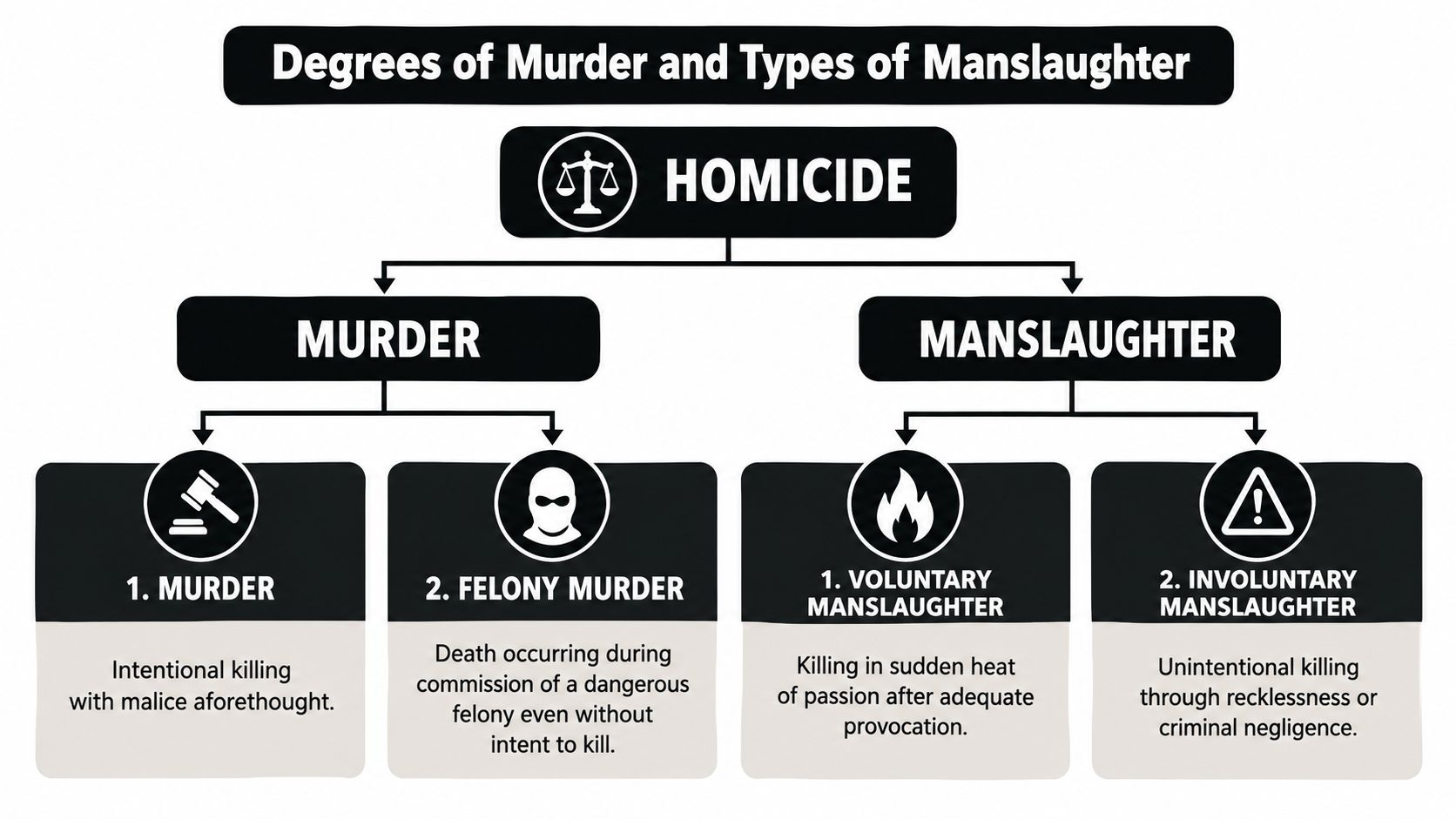
Indiana prosecutors don't look at every homicide as a single undifferentiated offense. They evaluate whether the evidence supports murder, felony murder, voluntary manslaughter, involuntary manslaughter, reckless homicide, or another charge tied to the specific conduct.
A deliberate ambush planned in advance presents the strongest murder theory. The State may rely on preparation, communications, travel, weapon acquisition, concealment, or conduct showing that the defendant reflected before acting. By contrast, felony murder focuses on a death occurring during the commission or attempted commission of a qualifying dangerous felony. The prosecutor may argue that the defendant is legally responsible for the death even if the defendant didn't specifically intend to kill.
Voluntary manslaughter is different. The defense theory is that the killing occurred during sudden heat of passion after adequate provocation, reducing the defendant's culpability below murder. A spouse who kills a partner moments after discovering infidelity might raise that theory, but the result would depend on the full facts, the timing, the conduct involved, and Indiana law.
Involuntary manslaughter focuses on an unintended death caused by criminally blameworthy conduct. A driver who texts, loses control, and kills a pedestrian might face a theory based on criminal negligence or reckless conduct, depending on the evidence and applicable statute. The State still must prove more than an unfortunate mistake.
The lesser offenses matter
Reckless homicide can occupy an important place in the charging analysis. It may fit facts that show dangerous disregard for safety without enough evidence of murder or manslaughter. The Indiana reckless homicide guide provides a focused explanation of how that offense differs from more serious homicide theories.
The label alone doesn't decide the case. Prosecutors examine the weapon, distance, injuries, witness accounts, forensic reconstruction, and what the defendant did before and after the death. Defense counsel should build a factual record that gives the prosecutor a legally credible reason to choose a lesser theory, not merely ask for leniency.
How Prosecutors Prove Intent and Choose the Charge
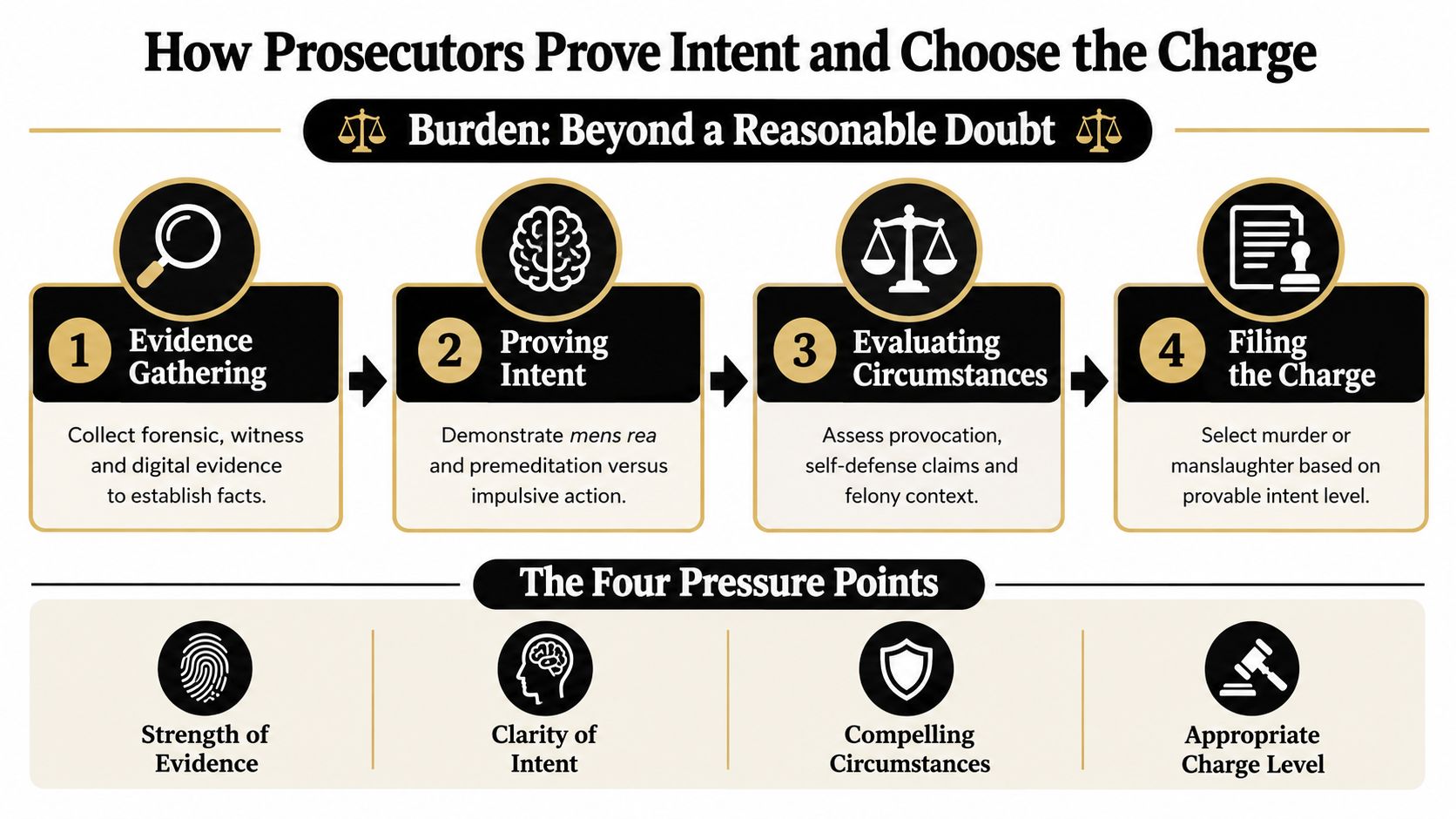
The prosecution must prove the charged offense beyond a reasonable doubt. Before filing, prosecutors and investigators usually assemble a theory from multiple evidence sources rather than relying on one fact. The question is not what likely happened. It is what a jury could reasonably find from admissible evidence.
Four pressure points shape the decision
Statements and digital communications can reveal planning, anger, fear, or an attempt to explain events. Text messages, social media posts, search history, recorded calls, and statements to witnesses may help the State show intent. They can also support the defense by showing confusion, an immediate threat, an attempt to retreat, or the absence of planning.
The instrument and injury pattern matter because prosecutors use them to infer purpose. A single impulsive act may support a reduced-culpability theory, while repeated wounds, a targeted body area, or continued conduct after the victim fell may strengthen a murder argument. A forensic pathologist's conclusions can either reinforce or weaken that inference.
Relationship history often becomes a major battleground. Prior threats, domestic violence allegations, stalking, jealousy, or escalating conflict may support intent. The defense must investigate whether those allegations are accurate, admissible, disputed, or missing context.
The confrontation itself includes provocation, retreat, self-defense, location, timing, and the sequence of actions. A sudden attack can support a defense theory, but prosecutors may argue that the defendant initiated the violence or continued after the danger ended.
Grand jury review, prosecutor screening, witness interviews, 911 audio, surveillance footage, autopsy findings, and firearms evidence can all affect the charging decision. A suppression motion may exclude a statement or search result. A credibility challenge may undermine the only witness who supplies intent. Those developments can change the negotiation from murder to manslaughter, or from manslaughter to an even lesser offense.
A defense lawyer should examine the Indiana rules of evidence and trial guide while evaluating whether the State's most damaging evidence can reach the jury.
Indiana Penalties for Murder and Manslaughter
Indiana sentencing exposure depends on the exact charge, the conviction, aggravating and mitigating circumstances, enhancements, and the defendant's criminal history. The following summary uses the sentencing figures identified in the provided Indiana framework and should not replace a charge-specific review of the current statutes.
| Charge | Felony Level | Advisory Range | Cap | Key Enhancement |
|---|---|---|---|---|
|
Murder |
Murder offense |
45 to 65 years advisory |
55-year cap identified in the provided framework |
Firearm enhancement under the Major Crimes Act may add 5 to 20 years consecutively on qualifying murder counts |
|
Felony murder |
Murder offense |
Same murder range identified in the provided framework |
Same murder cap identified in the provided framework |
Firearm enhancement may apply on qualifying counts |
|
Voluntary manslaughter |
Level 1 felony |
20 to 40 years advisory |
30-year cap |
The precise sentencing result depends on the conviction and case facts |
|
Involuntary manslaughter |
Level 5 felony |
1 to 6 years |
6 years |
Habitual offender enhancement may be possible |
|
Reckless homicide |
Level 6 felony |
Not specified in the provided data |
2.5 years |
The consequences depend on the charge and record |
The gap between these offenses can change the entire defense posture. Murder exposure may make a trial necessary even when the evidence is difficult, while a well-supported manslaughter theory may create a realistic basis for negotiation. A firearm enhancement can add consecutive time, so the defense must examine not only the homicide count but also how the State alleges weapon use.
Collateral consequences deserve early attention. A conviction can affect parole and credit classification, firearm rights, professional licensing, housing, family relationships, and immigration status. Sex-offender registration isn't a generic consequence of every homicide conviction, but counsel should review whether any separate offense or factual allegation creates a registration issue.
Indiana sentencing rules are technical and fact-specific. The Indiana sentencing guidelines resource can help explain the broader framework, but a lawyer must analyze the charging information and the defendant's record before predicting a likely outcome.
Real-World Hypotheticals That Change the Charge
The same death can support different charges because the surrounding facts change the prosecutor's theory. These examples are simplified, but they reflect the questions defense counsel asks during an early investigation.
A bar fight and one fatal punch
A person throws one punch after a heated exchange, the victim falls, and the injury proves fatal. If the defendant didn't use a weapon, didn't continue the attack, and the evidence shows a brief confrontation, prosecutors may consider reckless homicide or involuntary manslaughter theories.
The case moves toward voluntary manslaughter if the State believes the defendant acted during legally adequate provocation and sudden heat. It moves toward murder if witnesses, messages, video, or follow-up conduct show a deliberate decision to kill or an attack continuing after the threat ended. The fact most likely to flip the charge is the sequence captured by surveillance or independent witnesses.
A domestic shooting described as accidental
A defendant says a firearm discharged accidentally during a domestic confrontation. Prosecutors will examine the firearm's condition, the defendant's handling of it, muzzle direction, distance, shell casings, injuries, and statements made before and after the shooting.
Prior threats, efforts by the victim to leave, escalating conflict, or messages about harm may support a murder theory. Evidence of a genuine struggle, an unexpected movement, or a mechanical malfunction may support an accident or reduced-culpability defense. The decisive issue isn't the defendant's label for the event. It is whether physical evidence and witness testimony support that account.
A road-rage shooting
One driver fires after another person approaches aggressively. The first driver may claim self-defense, and the case could end in acquittal if the jury finds the force legally justified. If the defendant honestly feared harm but the response was legally unreasonable, the evidence may support a voluntary manslaughter theory in jurisdictions recognizing that form of mitigation.
A different driver who shoots into a moving vehicle after the immediate threat has passed may face murder charges based on intent and disregard for human life. The fact that most plausibly changes the result is whether the defendant faced an imminent deadly threat at the moment the shot was fired and whether the response was proportionate.
Defenses and What to Do If You Are Charged
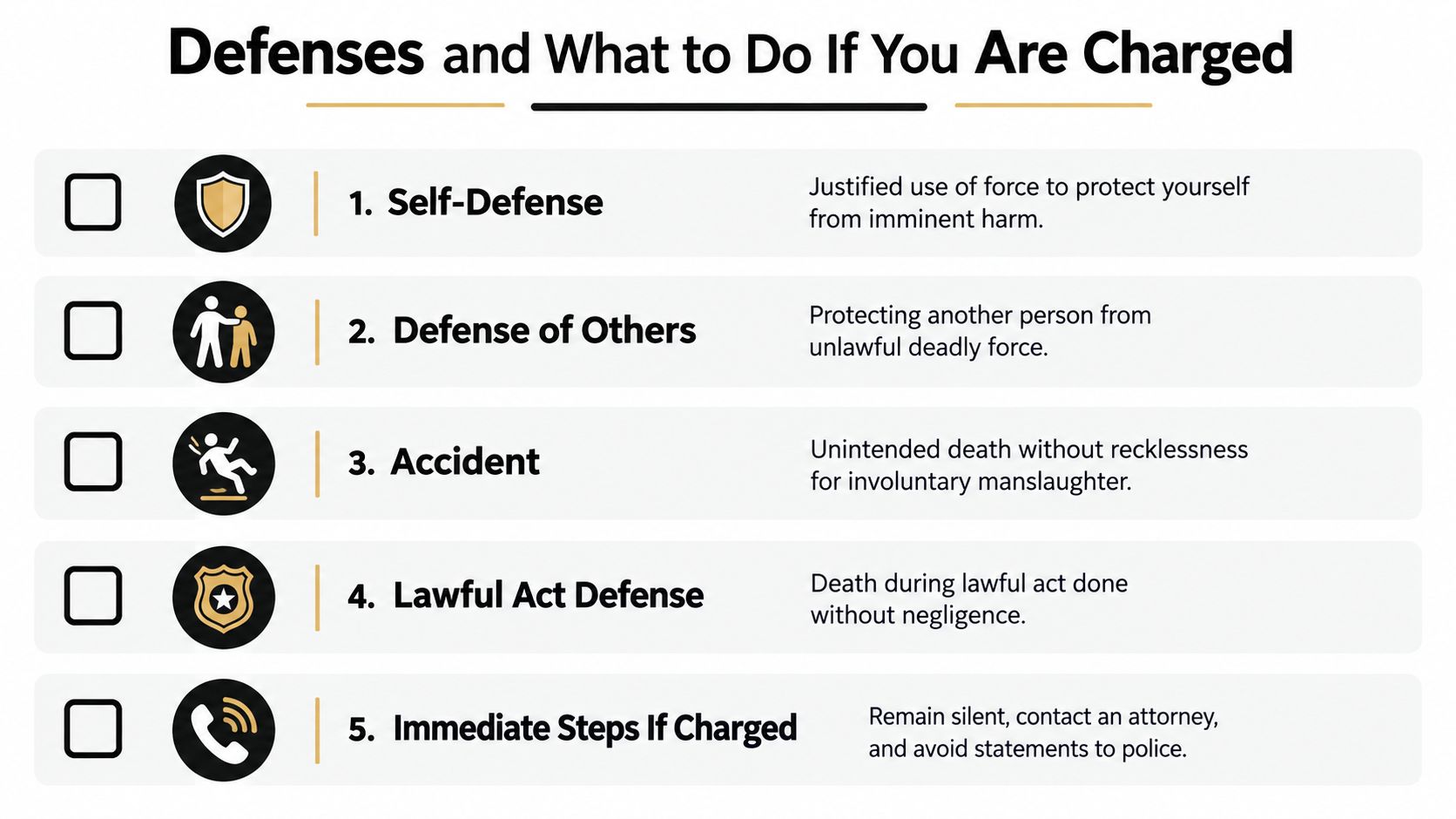
A homicide defense must match the State's theory. Self-defense and defense of others may apply to a murder or manslaughter allegation if the evidence shows an imminent unlawful threat and a legally justified response. The defense must develop the timeline, the defendant's perception, the other person's conduct, available escape routes, physical disparities, weapon evidence, and witness accounts.
For an involuntary manslaughter theory, accident may be viable if the death occurred without criminal negligence or recklessness. A lawful-act defense may also matter where the defendant was engaged in lawful conduct and used reasonable care. Those defenses depend heavily on forensic evidence and the precise statutory elements.
For voluntary manslaughter, counsel may present sudden heat, adequate provocation, lack of malice, or an imperfect self-defense theory where the facts and Indiana law permit it. In a murder case, the defense may challenge intent, causation, the reliability of forensic conclusions, the legality of searches, or the credibility of witnesses who claim the defendant planned the killing.
Immediate steps in Indiana
- Remain silent: Don't explain the incident to police, friends, cellmates, or online contacts.
- Refuse consent searches: Ask for a lawyer before consenting to searches or interviews.
- Preserve evidence: Save texts, photographs, videos, location information, clothing, and messages that support accident or self-defense.
- Identify witnesses: Write down names and contact information while memories remain fresh, without pressuring anyone about testimony.
- Avoid social media: Don't post, delete, or discuss the case online.
- Contact counsel early: Pre-charge investigation can address witness credibility, forensic issues, grand jury presentations, and prosecutor meetings before the State's theory becomes fixed.
If you or someone close to you is under investigation or charged with murder, manslaughter, or reckless homicide, contact the Law Office of Mark Nicholson for an early review of the evidence, charging theory, and available defenses. Visit Law Office of Mark Nicholson to request a consultation and begin protecting your rights before an interview, indictment, or plea decision narrows your options.


Comments
There are no comments for this post. Be the first and Add your Comment below.
Leave a Comment