
Indiana Rules of Evidence: A Trial Guide for Your Case
Indiana: A lot of people first hear about the Indiana rules of evidence at the worst possible moment. A prosecutor offers a lab report. An officer starts repeating what someone else said. An insurance lawyer tries to slip in something that makes you look bad but doesn't prove the point at issue.
That's when evidence law stops being abstract.
If you're charged with DUI, battery, a drug offense, or a gun offense, these rules can keep weak proof away from the jury. If you were hurt in a crash or another injury case, the same rules can help make sure the judge hears reliable medical proof, complete records, and the full story instead of a distorted one. In Indiana court, evidence fights often decide the case long before closing argument.
What Happens When Evidence Is Challenged in Court
The prosecutor offers a body-cam clip. Defense counsel objects before the jury hears the next sentence. In an injury trial, the insurance lawyer reaches for a stack of medical records, and the fight shifts from the witness stand to the judge.
That is how evidence disputes usually look in real court. Fast, technical, and often case-shaping.
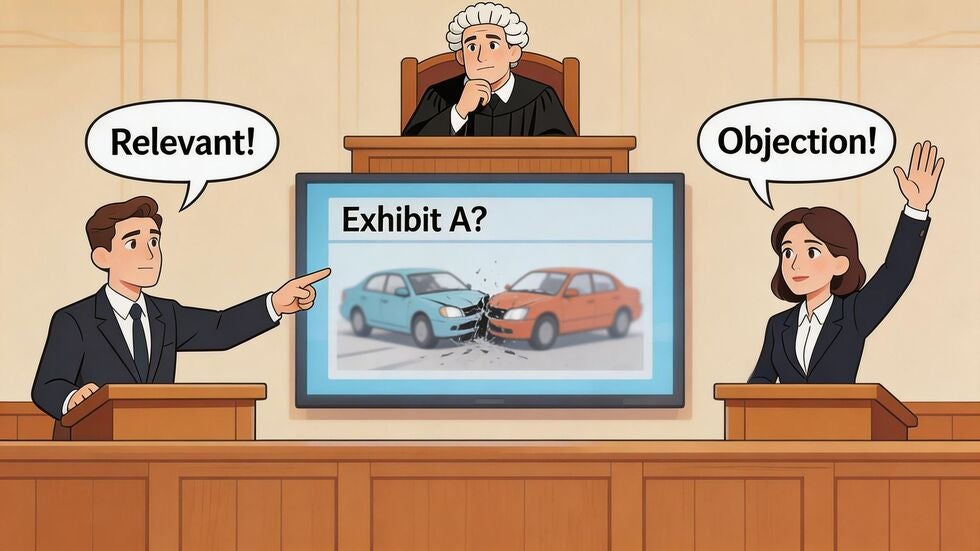
The judge decides what the jury is allowed to consider
Jurors do not get to hear everything one side wants to offer. The judge acts as the gatekeeper and rules on whether a photo, statement, report, text message, test result, or opinion meets Indiana's evidence rules.
That matters in both criminal and civil cases. In a DUI prosecution, the dispute may be over roadside statements, a breath test foundation, or whether an officer can repeat what a bystander said. In a car wreck case, the dispute may center on treatment records, repair photos, prior complaints of pain, or whether a witness knows what caused the crash.
Sometimes the objection is sustained and the jury never hears the evidence. Sometimes the judge lets it in, and the other side has to blunt the damage through cross-examination or a limiting instruction. Sometimes the most important ruling happens before trial, after written briefing and argument outside the jury's presence.
Practical point: Good evidence work starts well before the trial date. It starts with motions, witness preparation, exhibit review, and knowing which objections must be raised at the right moment to preserve the issue.
Why these fights start before anyone takes the stand
Clients often assume evidence objections are trial drama. In practice, many of the best evidentiary wins happen earlier.
A deposition can lock a witness into an answer that later supports impeachment. A sloppy chain of custody can support a motion to exclude. An unauthenticated screenshot may look persuasive in a demand package and fall apart in court. If your case includes sworn testimony before trial, this guide to understanding depositions for clients explains why that process affects later evidence disputes.
The trade-off is straightforward. Filing early motions can narrow the issues and prevent surprise. It can also show the other side where the pressure points are. Experienced trial lawyers make that choice on purpose, based on the judge, the facts, and whether the ruling is better sought before trial or in the moment.
The objections that matter most
Strong objections usually identify a specific legal defect, not a general complaint that the evidence feels unfair.
Common examples include:
- Lack of foundation: The lawyer offering the exhibit has not shown what it is, who created it, or how the witness knows it is accurate.
- Hearsay: The evidence depends on an out-of-court statement being accepted as true.
- Authentication problems: The proponent cannot show that the video, text, email, or record is what they claim it is.
- Unfair prejudice or confusion: The evidence may provoke emotion or distract the jury from the central issue.
- Improper opinion testimony: A witness starts giving conclusions that require expertise or invade the jury's role.
Weak objections usually fail for practical reasons. Counsel objects too late. Counsel states no ground. Counsel objects to testimony that could have been handled better with cross-examination than exclusion.
That is not a small distinction. In trial work, a correct objection made poorly can lose. A disciplined objection, made on time and with a clear ground, can keep out evidence that would have changed how the jury saw the whole case.
Core Principles of Evidence Relevancy and Prejudice
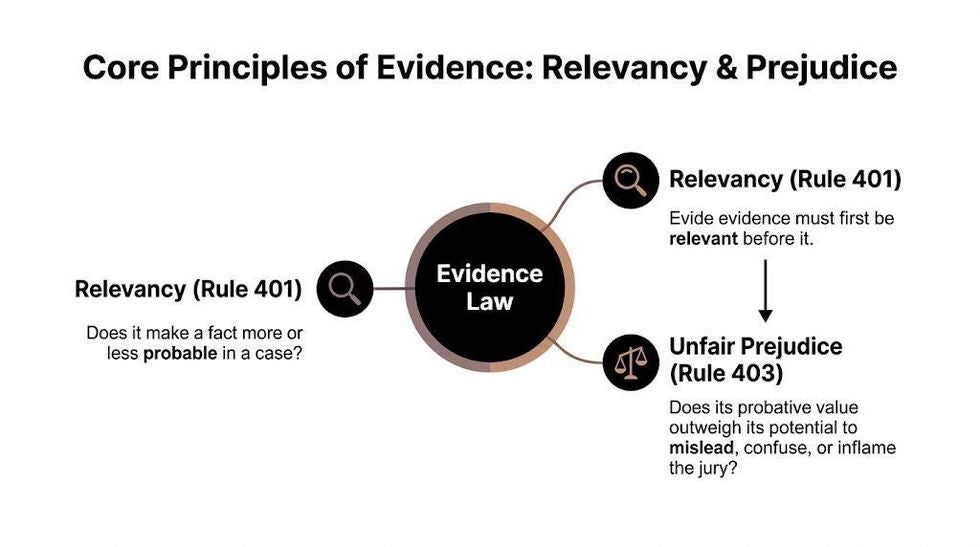
Most evidence fights in Indiana start with two questions.
First, does this evidence help prove or disprove something that matters? Second, even if it does, is it so unfair or distracting that the jury shouldn't see it?
Rule 401 asks whether it matters
Under Rule 401, evidence is relevant if it has any tendency to make a fact more or less probable. That's a low bar.
In a car crash case, fresh photos of vehicle damage are usually relevant. In a battery case, a witness who saw the argument shortly before the alleged strike may also be relevant. The point isn't whether the evidence wins the case by itself. The point is whether it helps the fact-finder answer a real dispute.
Think of Rule 401 like the courthouse gate. If the evidence doesn't connect to a fact that matters, it stays outside.
Rule 403 asks whether it's too risky
Relevant evidence can still be excluded. Rule 403 lets a judge keep it out if its probative value is substantially outweighed by the danger of unfair prejudice, confusion, or misleading the jury.
That balancing test shows up constantly in trial work.
A graphic injury photo may prove the extent of harm. It may also inflame emotions. A prior confrontation between the same people may provide context. It may also tempt the jury to decide the case based on dislike rather than proof.
Judges don't exclude evidence because it's harmful. They exclude it when the harm is unfair and outweighs the legitimate value of the proof.
How that balance plays out in real cases
In criminal defense, one of the biggest fights involves evidence that suggests a person is “the type” to commit the charged act. Lawyers often try to dress that argument up as context. Judges have to decide whether the evidence helps prove a disputed issue or just invites moral judgment.
In injury litigation, the fight often looks different. A defendant may want to highlight unrelated facts about the plaintiff that don't really answer how the injury happened or what damage followed. That may distract the jury from the actual liability and medical issues.
| Question | Why it matters in court |
|---|---|
|
Does it prove a disputed fact? |
If not, the judge may find it irrelevant. |
|
Is there a cleaner way to prove the same point? |
f yes, the judge may exclude the more inflammatory version. |
|
Will the jury misuse it? |
If likely, Rule 403 becomes stronger. |
Good lawyers frame the issue narrowly
The strongest relevance arguments are specific.
Instead of saying, “This is important background,” a better argument is, “This message shows the defendant knew the meeting time and location.” Instead of saying, “The jury should see all the photos,” a better argument is, “This photo shows the point of impact and supports the reconstruction.”
Specificity works. Vagueness usually doesn't.
What clients often misunderstand
Clients often think bad facts are automatically inadmissible. They aren't. If a bad fact helps prove something material, the judge may allow it.
Clients also assume that if something is relevant, it must come in. That's also wrong. Rule 403 is where trial lawyers do some of their best work. It's often the rule that keeps a case from turning into a referendum on emotion, personality, or side issues.
Understanding the Hearsay Rule and Its Key Exceptions
A trial can turn on a single sentence.
In a battery case, a witness starts to say, “His brother told me he admitted it.” In a car wreck case, an adjuster points to a note that says, “A bystander said the truck was speeding.” Those statements may sound persuasive, but courtroom proof has stricter rules. If the person who made the statement is not in court to be questioned, the judge may keep it out.
Here's the practical filter lawyers use:
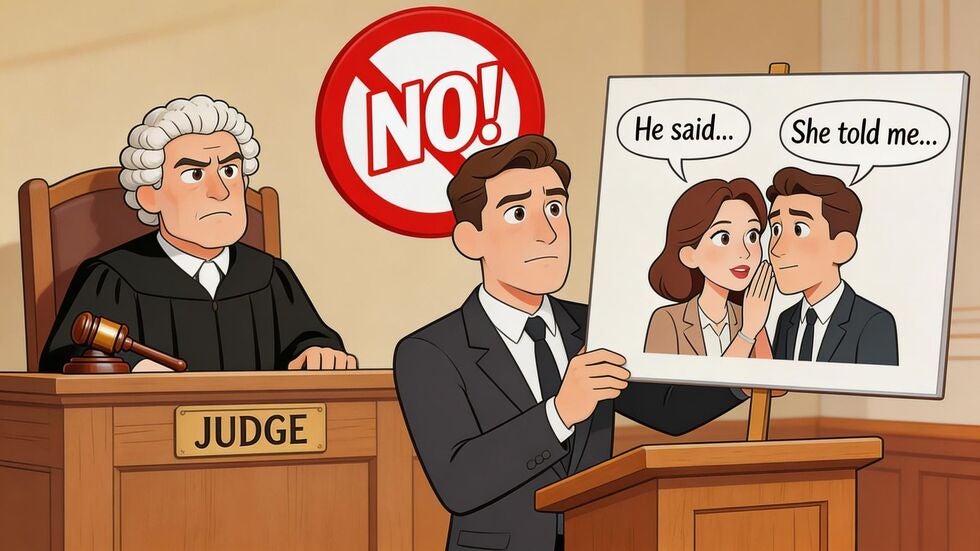
Hearsay usually means an out-of-court statement offered to prove the statement is true. The rule exists for a practical reason. Cross-examination tests whether the speaker saw what happened, remembered it correctly, had a motive to shade the story, or got it wrong.
That matters in real cases more than clients expect. Prosecutors often want a damaging statement in front of the jury even when the actual speaker is missing, evasive, or inconsistent. In injury litigation, insurance lawyers may try to use records, reports, or secondhand comments to weaken causation without producing the person behind the statement. A hearsay objection can take away a polished narrative and force the other side to prove the point with admissible testimony.
Three exceptions that show up often
Excited utterance
This exception comes up after collisions, fights, falls, and other fast-moving events. A person who blurts out, “He ran the red light,” seconds after impact may be allowed if the statement was made while the stress of the event was still controlling the speaker.
Timing and condition matter. If the person had time to calm down, talk to others, or shape the story, the argument gets weaker. I look closely at the gap between the event and the statement, who was present, and whether the speaker was still visibly shaken.
Statements for medical diagnosis or treatment
Statements made for diagnosis or treatment often carry real weight in both personal injury and criminal cases involving alleged bodily harm. If a patient tells an ER doctor where the pain started, what body part struck the dashboard, or what symptoms began immediately after the incident, those statements may come in because patients usually have a strong reason to be accurate when seeking care.
This exception can help or hurt. In a defense case, treatment records sometimes show a different timeline, a prior injury, or a mechanism of injury that does not match later testimony. In a plaintiff's case, consistent medical history can tie the injury directly to the event and cut off arguments that the problem came from somewhere else.
Present sense impression
A present sense impression is a statement describing an event while the person is perceiving it or immediately after. A passenger saying, “He's crossing the center line,” during the drive is the classic example.
The closer in time, the better the argument. Once minutes pass and reflection starts, judges become more cautious.
Statements that sound like hearsay but may come in anyway
Lawyers also fight over statements that are offered for a reason other than truth. The wording matters, but the core dispute is over purpose.
A statement may be offered to show why an officer took a next step, why a property owner had notice of a hazard, or why a person acted out of fear. Those are legitimate uses in some cases. They are also easy to abuse. Judges know that a lawyer can dress up a truth argument as “effect on the listener” and still try to slide the accusation in through the side door.
That is why hearsay objections need precision. A good objection identifies the exact statement, the exact purpose offered, and why that purpose is pretext or limited. A good response does the same.
If old records or prior statements are part of the problem, cleaning up your record outside the trial context can matter too, especially in criminal matters involving background history and credibility issues. Our guide to expungement in Indiana explains that process.
Why hearsay fights often decide the case
Some evidence disputes are marginal. Hearsay disputes often are not.
In a criminal case, the State may have a weaker file than it first appears if the strongest accusation depends on a non-testifying witness. In a personal injury case, the defense may attack causation through layers of notes, summaries, and secondhand reporting that do not hold up once each statement is tested separately.
A strong hearsay objection does more than block one answer. It can force the case back onto witnesses with firsthand knowledge, where credibility can be tested in front of the jury.
When Can Your Past Be Used Against You in Indiana
One of the first questions clients ask is simple and anxious at the same time. “Can they bring up my past?”
Usually, not for the reason people fear most.
Rule 404 starts with a basic protection
Indiana Rule 404 generally blocks using character evidence to prove conduct in conformity with that character. In plain English, the State or opposing party usually can't argue, “You did bad things before, so you probably did this too.”
That rule matters because juries are made of people. People may give too much weight to a prior accusation, a prior conflict, or an ugly chapter in someone's life. Rule 404 helps keep the trial focused on the event being litigated.
The rule has also been refined through judicial interpretation over time, including in the area of character evidence, as noted in the discussion of Indiana evidence developments in the verified material above.
The exceptions are where the fights happen
The ban is not absolute. Prior acts can come in for another purpose, such as motive, intent, opportunity, identity, preparation, or plan.
That's where courtroom arguments get sharp.
If the prosecution says a prior act shows intent rather than bad character, the judge has to decide whether the evidence serves that permitted purpose or whether it's just character evidence with a new label. In civil cases, a similar issue comes up when one side tries to package old conduct as “context” or “course of dealing.”
Here are the practical trade-offs:
- A real connection helps admission: If the earlier act closely connects to a disputed issue, the judge may allow it.
- A weak connection invites exclusion: If the earlier event mainly paints you as a bad person, the judge may keep it out.
- Rule 403 still applies: Even if the evidence fits an exception, the court can exclude it if the unfair prejudice outweighs the value.
Past acts often come in not because they are old, but because a lawyer persuades the judge they answer a present disputed question.
Prior convictions and witness truthfulness are different
Clients often lump everything together. Character evidence under Rule 404 is not the same as impeachment by conviction under Rule 609.
Rule 609 deals with whether a prior conviction may be used to attack a witness's credibility. That is a narrower purpose. The theory is not “you committed this act before, so you committed this one too.” The theory is “this conviction may bear on whether the jury should trust your testimony.”
That distinction matters.
If you testify, your prior record may become relevant in a different way than if you remain silent. Trial strategy often turns on that decision. Lawyers have to weigh the benefit of telling your story directly against the risk of opening the door to impeachment.
What actually helps in court
The best defense approach is usually not broad outrage. It's precision.
A focused motion should identify:
- What prior act the other side wants to use
- What claimed purpose they offer
- Why that purpose is pretext or too thin
- Why Rule 403 still bars it
In some cases, older records may also affect what remains visible in the first place. If your concern is a prior Indiana record, this guide to expungement in Indiana is a useful starting point.
What clients should remember
A prior mistake does not give the other side unlimited permission to define you by it. Courts know the danger of guilt by character.
But this is also an area where false confidence hurts. If your past includes convictions, prior allegations, or related incidents, your lawyer needs to examine them early. Waiting until trial to think about Rule 404 problems is usually too late.
Expert Witnesses and the Rule 702 Reliability Test
A case can swing on one witness with a lab coat, a medical degree, or a reconstruction chart.
I see that in both criminal and injury cases. In a DUI case, the State may rely on a toxicologist to make the chemical test sound unshakable. In a car wreck case, an insurance company may hire a doctor who says your back injury was already there and the crash changed nothing. If that opinion gets in front of the jury without a real challenge, it can frame the whole trial before the first fact witness finishes testifying.
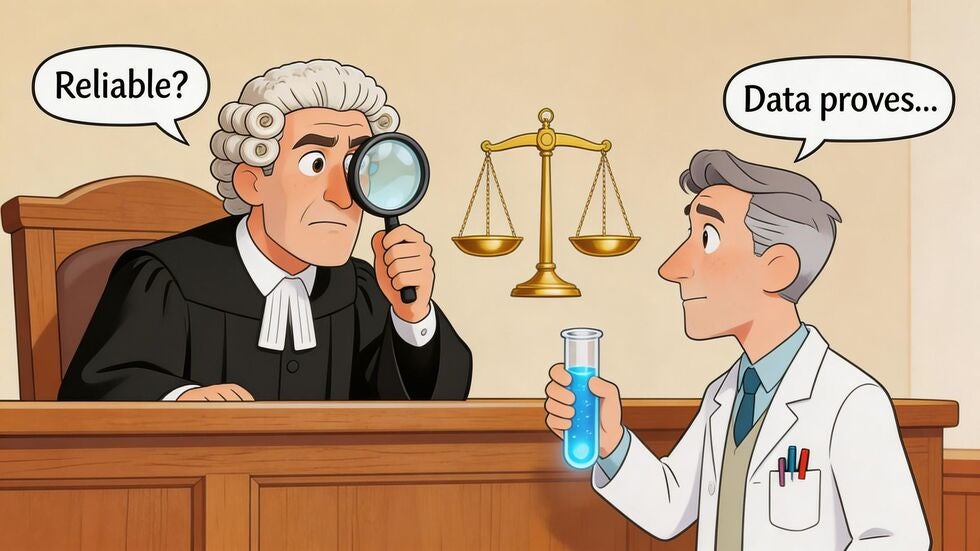
Indiana screens expert opinions for reliability
Under Indiana Rule of Evidence 702, the court does not admit expert testimony just because the witness has credentials. The judge has to decide whether the expert's knowledge will help the jury and, for scientific testimony, whether the principles behind the opinion are reliable. That basic framework is summarized in this overview of Indiana expert witness admissibility rules.
In practice, the question is usually narrower than clients expect. The fight is often not about whether the expert is smart. The fight is whether the expert used a reliable method, relied on adequate facts, and connected that method to the facts of your case instead of filling gaps with assumptions.
That last point matters.
A polished expert can make a weak opinion sound stronger than it is. Good trial work strips away the presentation and tests the foundation.
What lawyers actually attack
The strongest Rule 702 challenges usually focus on the work, not the title. A court will want concrete answers to questions like:
- What information did the expert review
- Did the expert ignore records that point the other way
- Is the method accepted and testable
- Was the method applied correctly in this case
- Does the opinion fit the disputed issue the jury has to decide
In a criminal case, that may mean pressing a forensic witness on contamination, chain of custody problems, calibration records, or whether the conclusion goes beyond what the testing can support. In a personal injury case, it may mean showing that a causation opinion skips over prior symptoms, treatment gaps, later accidents, or imaging that does not match the expert's conclusion.
Sometimes the best attack is timing. Indiana trial courts often set expert disclosure deadlines through case management orders rather than one uniform statewide schedule. Lawyers who track those dates carefully can pin the other side down early, force a report into the open, and file a motion before the opinion hardens into trial testimony. This becomes even more important in cases involving technical location evidence or device data, including issues discussed in our guide on whether police can track your cell phone.
Pretrial hearings can change settlement and trial strategy
A Rule 702 challenge is not just an academic motion.
If the State loses its key forensic opinion, the pressure on a defendant can change overnight. If the defense knocks out the insurer's medical causation expert, settlement value often changes too. Even when the judge allows the expert to testify, forcing the witness to explain the method under oath before trial can expose concessions that become strong cross-examination points later.
That is why I prepare these fights from the records up. Get the report. Compare it to the medical chart, lab records, police paperwork, photographs, and timeline. Look for the unsupported step in the reasoning. Courts usually do not exclude an expert because the witness is hired often or charges a high fee. Courts are far more interested in whether the opinion rests on reliable principles and a sound application of those principles.
What clients should take from this
Expert testimony can help a case or damage it fast. The label "expert" does not end the analysis, and it should never end the preparation.
A serious Rule 702 review asks whether the opinion is reliable enough to reach the jury at all. In the courtroom, that is often the difference between evidence that sounds persuasive and evidence that survives scrutiny.
Authenticating Digital and Electronic Evidence
Digital proof now shows up in almost every kind of case. Text messages. Ring footage. body cam video. Social media posts. Surveillance clips. Location data references. Screenshots.
The hard part isn't just getting the file. The hard part is proving what it is.
Rule 901 asks a basic but serious question
Authentication under Rule 901 means showing that the evidence is what the proponent claims it is.
That sounds simple until the exhibit is a screenshot with no sender information, a clipped video with no full recording, or a social media post that could have been edited, reposted, or taken out of sequence. The problem is common enough that there is still little practical guidance for clients dealing with digital proof in Indiana cases involving DUI, battery, and drug charges, even though Rule 901 and Rule 106 directly matter, as noted in this discussion of Indiana rules and digital evidence issues.
What lawyers look for with digital proof
Authentication usually comes from context, witnesses, and technical details together.
A lawyer may ask:
- Who created it: Who took the photo, recorded the clip, or sent the message?
- How was it stored: Was the file kept on a phone, platform, police system, or cloud account?
- Does the content match surrounding facts: Names, timing, location, and reply patterns matter.
- Is there a missing segment: A short clip may hide the critical beginning or end.
A screenshot alone often isn't enough. It may show words on a screen, but not who sent them, when they were sent, whether they were altered, or what came right before and after.
Rule 106 matters more than people think
Rule 106 is often called the rule of completeness. It can be a powerful tool when one side tries to use only the cleanest excerpt of a longer recording or exchange.
If the State offers a short body cam segment showing anger after an arrest, the defense may demand the earlier portion showing confusion, pain, or a calm explanation. If an insurer points to one text message, the full thread may change the meaning.
That issue comes up frequently with phones and police investigations. If your concern involves mobile data and law enforcement, this article on whether police can track your cell phone gives useful background.
What actually persuades judges
Judges usually want a practical chain of logic, not drama.
The best authentication arguments identify the witness who can verify the item, the surrounding circumstances that tie it to the parties, and any reasons the exhibit may be incomplete or misleading. The best objections do the opposite. They point out ambiguity, missing context, or signs the exhibit could be something other than what the offering party claims.
How to Use the Rules Strategically in Your Case
Knowing the rules is only part of trial work. Using them at the right time is the core skill.
A lot of evidence fights are won in motions, sidebars, and quick objections that happen before a witness finishes the sentence.
Objections are real-time tools
If improper evidence comes in and nobody objects, the problem may be hard to fix. In practice, many issues are “use it or lose it” moments. A lawyer has to recognize the problem and raise it clearly enough for the judge to rule.
That means objections need both timing and precision.
Here are some of the courtroom objections clients hear most often:
| Objection | Plain English Meaning | Simple Example |
|---|---|---|
|
Hearsay |
The witness is repeating an out-of-court statement for its truth |
“My neighbor told me the driver was drunk.” |
|
Relevance |
The evidence doesn't help prove a fact that matters |
Asking about an unrelated argument from years ago |
|
Leading |
The question suggests the desired answer, usually on direct examination |
“You saw him run the stop sign, right?” |
|
Foundation |
The lawyer hasn't shown what the exhibit is or how the witness knows about it |
Offering a photo without showing who took it |
|
Speculation |
The witness is guessing instead of testifying from actual knowledge |
“He looked like he planned to hit her.” |
Motions in limine can prevent damage before trial
Some of the best evidence work happens before the jury walks in.
A motion in limine asks the judge to bar certain evidence or arguments in advance. That can matter when the risk of unfair prejudice is high. If the jury hears a damaging statement and the judge later tells them to ignore it, the bell may already be impossible to unring.
That's why pretrial motions often target:
- Prior bad acts
- Inflammatory photos or labels
- Weak expert opinions
- Partial recordings
- Improper hearsay narratives
Strategy is about sequence, not just substance
Strong trial lawyers build an evidence plan in order.
First, identify the harmful proof likely to appear. Next, decide whether to attack it before trial, at trial, or both. Then prepare the foundation for your own exhibits and witnesses so you don't lose on technical grounds.
A courtroom objection works best when it's the final step in a plan, not the first time anyone has thought about the issue.
What clients can do to help
Clients affect evidence strategy more than they realize.
Save the original messages. Keep the full video, not just a clip. Don't edit screenshots. Tell your lawyer about prior cases, prior statements, and treatment history early. Surprise facts create evidence problems. Early disclosure gives your lawyer room to prepare motions, responses, and backup arguments.
Answers to Your Pressing Evidence Questions
Can my statements to police be used in court
Sometimes yes. Sometimes no. The answer depends on how the statement was obtained, whether Miranda applies, whether the statement was voluntary, and whether there's another basis to challenge admissibility.
What is chain of custody
It's the proof that physical evidence remained identified and handled in a way that supports reliability. In drug or gun cases, breaks in that chain can raise real questions about whether the item tested or shown in court is the same item seized.
Can illegally obtained evidence be suppressed
Yes, in some circumstances. If officers searched without lawful authority, exceeded the scope of the search, or violated constitutional protections, the defense may seek suppression. That issue usually arises through pretrial motion practice rather than during trial itself.
Do all evidence problems go to the jury
No. Many are decided by the judge first. That includes questions involving hearsay, expert reliability, authentication, and suppression.
Is a bad fact always admissible if it is true
No. Truth alone doesn't make evidence admissible. The evidence still has to satisfy the applicable rules.
If you're dealing with criminal charges, an injury claim, or a civil rights case where the facts will turn on what evidence comes in and what stays out, the Law Office of Mark Nicholson can help you evaluate the case early, challenge weak proof aggressively, and build a strategy around the evidence rules that will control the outcome.


Comments
There are no comments for this post. Be the first and Add your Comment below.
Leave a Comment