

The call may have started as an argument, but the consequences can become real before anyone has time to process what happened. An Indianapolis man might be pulled over on I-70 after a 911 hang-up call, handcuffed in his own front yard while neighbors watch, and booked on domestic battery under Indiana Code 35-42-2-1.3. His first question is usually, “How can the alleged victim drop the charges?”
That question reflects the most common misunderstanding in Indiana domestic battery cases. The alleged victim can tell the prosecutor what they want, but they don't own the criminal case. The State of Indiana decides whether to file, amend, negotiate, or dismiss the charge. A successful defense therefore focuses on the evidence, legal defects, witness availability, and a resolution the prosecutor can justify.
The practical path runs from the first hours after arrest through discovery, motions, negotiation, dismissal, diversion, or trial. What follows is the approach I use when evaluating these cases: protect the client from avoidable damage, preserve evidence, test the State's proof, and present a resolution that addresses the weaknesses in the file without creating new problems.
Facing Domestic Violence Charges in Indiana
The first 72 hours matter more than most defendants realize. Bond conditions may restrict contact with a spouse or partner, require a defendant to leave the home, or impose a no-contact order. The alleged victim may feel pressure from family members, police, or the defendant to “drop it,” but any direct communication can create a bond violation or a separate investigation.
Indiana domestic battery is generally charged as either a Class A misdemeanor or a Level 6 felony, depending on the facts and the defendant's record. Prior convictions, bodily injury, and the presence of a child under 16 can affect the level of the charge. The exact charging language matters, so don't assume the police narrative and the formal information say the same thing.
The first objective is not convincing the alleged victim to change the story. It's preventing the State from gaining additional evidence against you.
The first hours after arrest
Start with silence. Invoke your right to remain silent and request an attorney before speaking with police, detectives, victim advocates, or anyone else involved in the investigation. A defendant's attempt to explain the argument often supplies admissions, details that conflict with the 911 call, or statements the prosecutor later characterizes as consciousness of guilt.
Next, preserve evidence immediately:
- Secure digital recordings. Ask a trusted family member to download doorbell footage, home-security video, text messages, and relevant photographs. Cloud systems can overwrite or delete files, so preserving a copy within the first 48 hours is prudent.
- Document the scene. Photograph injuries, damaged property, scattered objects, clothing, and room layouts from multiple angles. Preserve the original files and their timestamps rather than editing or sending only screenshots.
- Identify neutral witnesses. Write down the names and contact information of neighbors, relatives, coworkers, or other people who saw the parties before, during, or after the incident. Don't coach them or ask them to coordinate stories.
- Collect corroborating records. School, work, transportation, and medical records may establish where you were, when you arrived, or what condition you were in. Give those materials to counsel rather than trying to explain them directly to the prosecutor.
- Follow every bond condition. Don't call, text, email, message through a friend, or communicate through social media unless your lawyer and the court expressly authorize the contact. Even a message that says “I'm sorry” can be used as evidence or treated as an attempted violation.
Indiana's approach reflects a broader development in domestic violence prosecution. Federal guidance issued to Canadian police and Crown offices in 1983, followed by spousal assault policies in most Canadian provinces by 1985, helped establish the no-drop model, where prosecutors rely less on a victim's preference. A Canadian review cited a Massachusetts program in which about 30% of cases were dismissed or nolle prossed after the victim requested dismissal, while the broader literature cited in that review found roughly 55% of victims cooperated with prosecution. The Canadian Justice Department review explains why prosecutors developed methods using 911 recordings, police testimony, photographs, and other evidence.
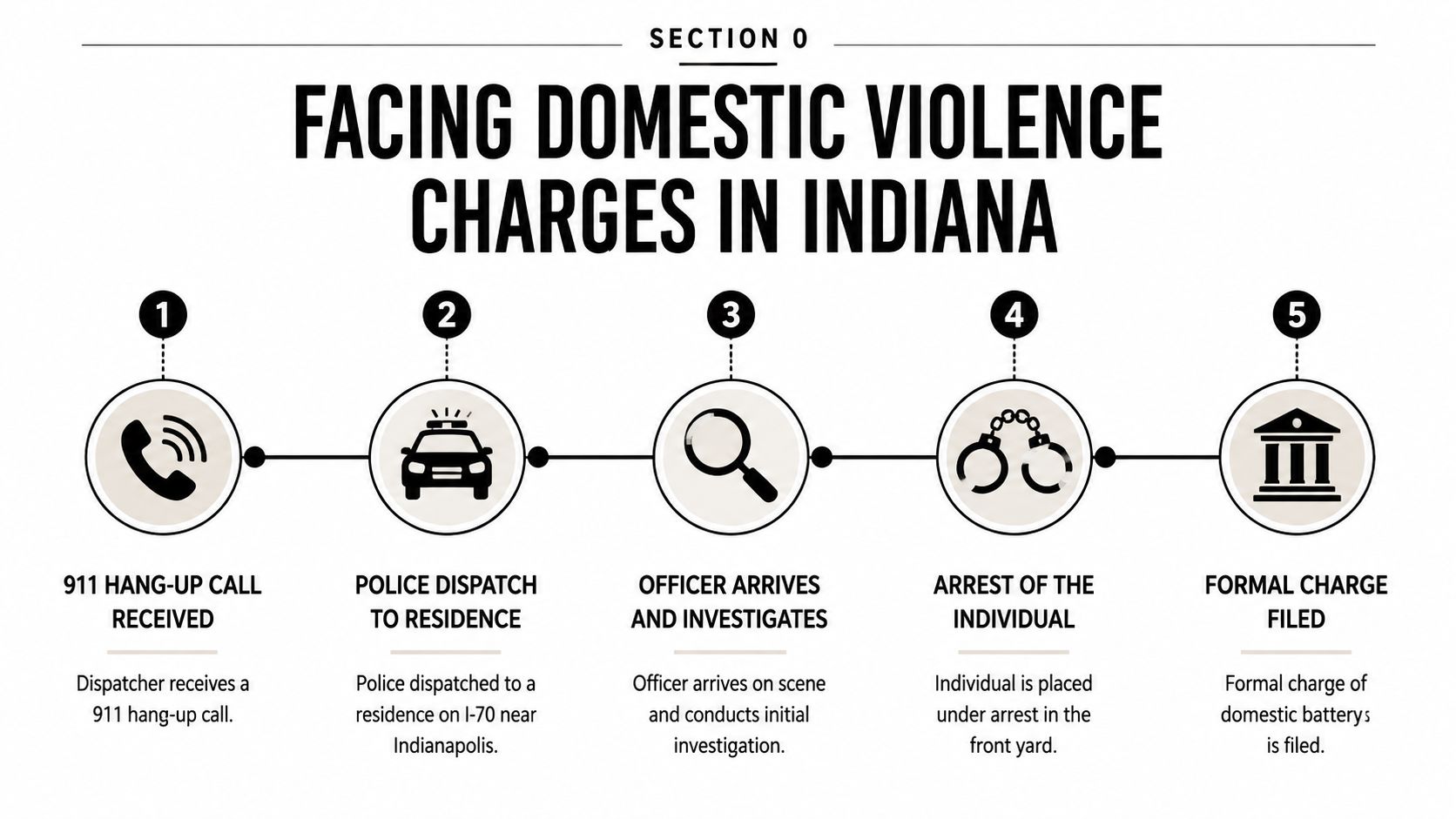
The roadmap is straightforward, although the execution isn't. Counsel reviews the charging information, bond order, probable cause affidavit, 911 materials, body-camera evidence, medical documentation, digital communications, and witness accounts. The defense then decides whether the strongest move is a dismissal motion, suppression motion, evidentiary challenge, negotiated reduction, diversion request, or trial preparation.
Building Your Evidence Strategy the Prosecution Cannot Ignore
Domestic battery cases often turn on corroboration. A recantation can weaken the State's case, but it won't erase independent evidence. Prosecutors in Marion, Hamilton, Lake, and Allen counties usually need to know exactly what the defense can prove, what the State cannot prove, and whether a contested item will survive an evidentiary hearing.
Five evidence categories
911 audio and CAD records can reveal what the caller said before officers arrived, whether a third party made the call, and whether the caller immediately disputed the report. Counsel may request records through Indiana's public-records process or issue a subpoena to the dispatching public safety answering point.
Body-worn camera footage may show the first description of the event, the condition of the parties, statements made spontaneously, and what officers observed. Agencies don't always volunteer complete footage, so a formal discovery request or subpoena may be necessary.
Medical and EMS records can contain injury photographs, treatment notes, and statements made during care. A lawyer typically obtains them through a subpoena that complies with medical-privacy requirements. The records may support the accusation, undermine the claimed mechanism of injury, or show that no treatment occurred.
Texts and social-media threads must be preserved as complete conversations, not selected screenshots. Forensic extraction can help authenticate the messages under Indiana evidence rules and reveal timing, deleted portions, follow-up communications, or context omitted from the police report. For a broader discussion of authentication and courtroom proof, review this Indiana Rules of Evidence trial guide.
Neutral witness statements can be obtained by a private investigator, including signed or recorded accounts from neighbors, family members, or bystanders. The value increases when the witness describes what they personally saw or heard rather than repeating what someone later told them.
| Evidence Type | How to Obtain | Prosecutor Weight |
|---|---|---|
|
911 audio and CAD records |
Public-records request or subpoena |
High when the recording conflicts with later accounts |
|
Body-camera footage |
Discovery request or agency subpoena |
High when it captures spontaneous statements or officer observations |
|
Medical and EMS records |
Privacy-compliant subpoena |
High when injuries or treatment are disputed |
|
Text and social-media threads |
Forensic preservation and authentication |
High when timing and context affect intent |
|
Neutral witness statements |
Private investigator interviews and sworn statements |
High when the witness has no apparent stake in the outcome |
The defense isn't collecting evidence merely to create a larger file. The purpose is to identify whether the State's proof confirms the allegation, contradicts it, or leaves a gap that makes a trial difficult to prove beyond a reasonable doubt.
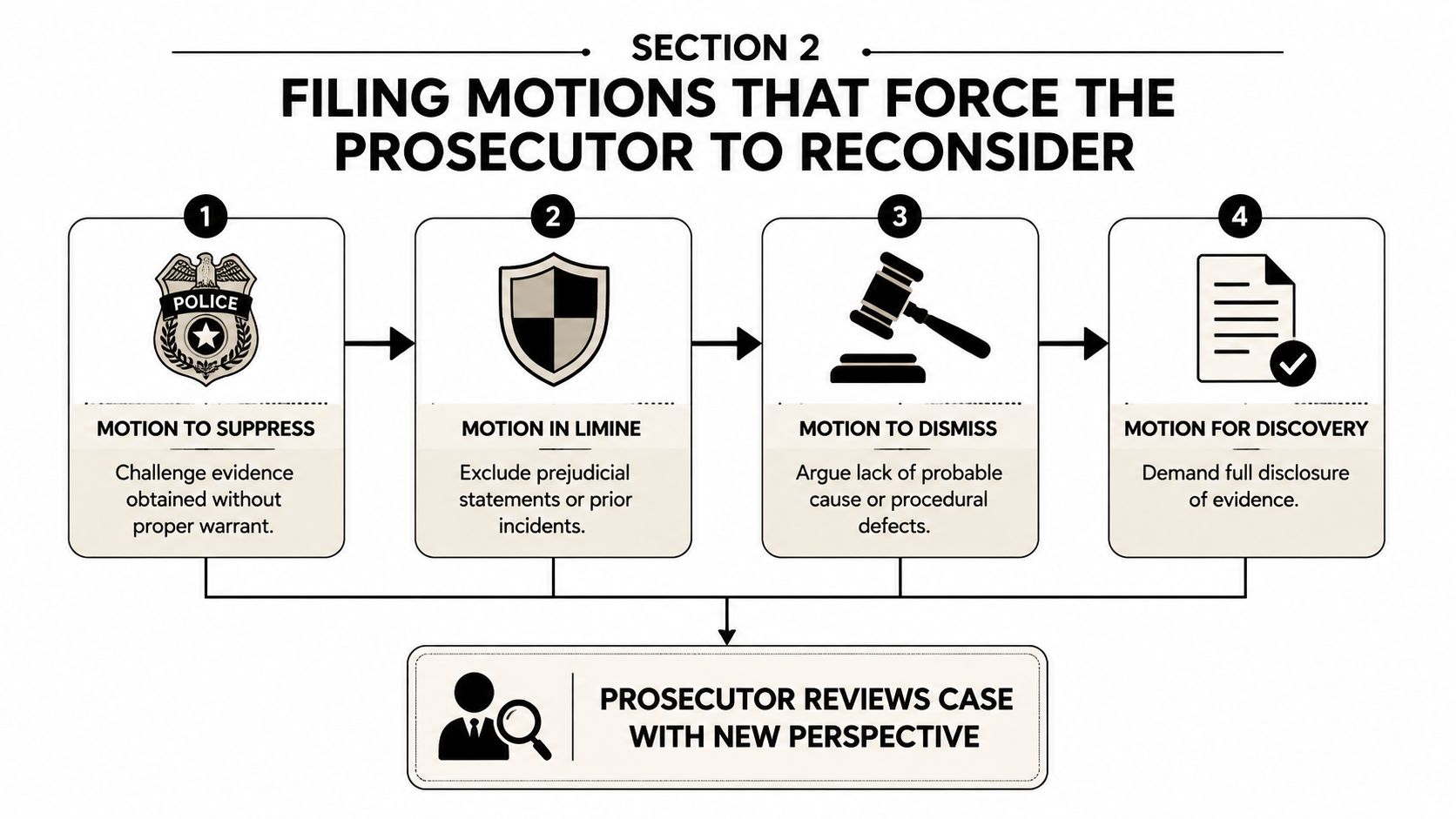
Filing Motions That Force the Prosecutor to Reconsider
A motion is useful only when it threatens to remove evidence the prosecutor needs. Filing boilerplate motions without attaching the underlying recording, transcript, affidavit, or timeline rarely changes the case. The strongest motion practice gives the judge a concrete legal question and gives the prosecutor a clear reason to reassess the file.
Four pressure points
A motion to dismiss can challenge insufficient probable cause, defective charging procedures, or other legal shortcomings. Counsel must tie the argument to the actual charging document and probable cause materials. A dismissal request isn't a substitute for arguing that the evidence is merely weak at trial.
A motion to suppress targets statements obtained during custodial interrogation without the required warnings, or evidence obtained through an unlawful search. The defense may need the recording, arrest timeline, officer reports, and testimony showing when questioning began and whether the defendant was free to leave.
A motion in limine can seek to prevent the State from presenting prior-bad-act evidence under Indiana Evidence Rule 404(B). Prior allegations aren't automatically admissible to prove the charged conduct. The prosecutor must identify a proper non-character purpose and satisfy the applicable balancing requirements.
A Franks motion challenges material false statements or omissions in a probable cause affidavit. This is not a general invitation to dispute the officer's conclusions. The defense must make a substantial showing, usually through documents, recordings, or testimony, and show that the challenged material mattered to probable cause.
Timing and preservation
Counsel should track the deadlines and hearings under Indiana Criminal Rule 4, file motions before the relevant evidentiary hearing or trial, and preserve objections for review. If the court denies a motion, the defense must make a clear record, request specific findings when appropriate, and preserve issues under the applicable trial rules, including Trial Rule 59 where relevant.
A motion earns leverage when the prosecutor can see the exhibit, understand the defect, and predict the risk of losing the evidence.
The State may respond by amending the information, defending the evidence, reducing the charge, or offering diversion. A prosecutor who sees a genuine suppression risk may prefer a controlled resolution over a hearing that could damage the entire case.
Diversion Programs and Plea Options That Actually Work
Indiana doesn't offer one statewide answer for every domestic battery defendant. Eligibility depends on the county, charge level, prior record, prosecutor, alleged facts, and program requirements. A defendant who qualifies for a misdemeanor diversion program may have options that aren't available in a Level 6 felony case.
Comparing practical outcomes
Pretrial diversion under Indiana Code 33-39-1-8 may allow an eligible defendant to complete conditions without entering a conviction. Prosecutors typically examine the defendant's prior record, the strength of the evidence, the alleged victim's position when the program requires participation, and whether counseling or a batterer intervention program is appropriate.
Deferred prosecution programs vary by county. Marion, Allen, St. Joseph, and Lake counties may use different screening standards, completion terms, and dismissal procedures. A lawyer should obtain the actual local requirements instead of promising that a particular program is available.
Negotiated pleas can include a Class A misdemeanor domestic battery conviction, a lesser-included offense such as disorderly conduct, or Class B misdemeanor reckless conduct when the facts support that result. These alternatives may reduce exposure, but they can still affect employment, housing, firearms, immigration, and future charging decisions.
A conditional discharge under Indiana Code 35-48-2-22 may be relevant when substance use contributed to the incident, although it isn't a universal domestic battery solution. Prosecutor discretion remains central, and a defendant shouldn't accept a plea without understanding the long-term record consequences.
| Program/Plea | Eligibility | Duration | Record Impact |
|---|---|---|---|
|
Pretrial diversion |
Program and prosecutor requirements, often focused on record and charge |
Set by written agreement |
May avoid conviction if completed successfully |
|
County deferred prosecution |
Varies by county and charge |
Set by local program |
Often allows dismissal after compliance |
|
Lesser-included plea |
Facts and prosecutor approval must support reduction |
Court-imposed sentence or conditions |
Creates a conviction, with consequences depending on offense |
|
Conditional discharge |
Case-specific statutory and factual requirements |
Set by court |
May provide a different resolution than a standard conviction |
Successful graduates may later qualify for relief under Indiana's Second Chance Law, but a dismissal, diversion, or reduced plea doesn't automatically erase every record. The lawyer should negotiate the disposition and the future record remedy together.
Negotiating Directly With the Indiana Prosecutor
The assigned deputy prosecutor has a caseload, a supervisor, court deadlines, and a responsibility to protect the public while making provable charging decisions. Treating that lawyer as an enemy usually produces less information and fewer options. A professional defense presentation gives the prosecutor a reason to recommend dismissal, reduction, or diversion internally.
The defense packet should be concise and verifiable. Include the charging information, a timeline, the key 911 or body-camera issue, medical or digital evidence that changes the analysis, witness contact information, and a proposed resolution. Don't bury the strongest point under a long personal narrative.
Lead with the proof problem, not the client's frustration. Counsel might write:
“The defense position is that the State cannot prove the charged conduct beyond a reasonable doubt because the contemporaneous recording conflicts with the later account. We're prepared to litigate the admissibility and credibility issues, but we're asking the office to consider dismissal or the attached diversion resolution.”
That language signals readiness without threatening the prosecutor personally. It also gives a supervisor enough information to evaluate the request without rebuilding the file.
Timing and communication
Written offer exchanges work best when tied to an upcoming pretrial conference or discovery deadline. Send the materials early enough for review, then follow up with a specific question: whether the office will consider dismissal, a lesser offense, diversion, or a revised bond condition.
A defense-initiated sentencing memorandum can help when the prosecutor is considering a plea. It should address employment, treatment, caregiving, compliance with bond, and the practical consequences of a conviction. It shouldn't attack the alleged victim or minimize documented injuries.
The alleged victim should not become the defense team's negotiator. Counsel must never direct the client to pressure, coach, threaten, or persuade that person. A victim advocate may communicate lawful information about available services and preferences, but the prosecutor may ignore the preference when independent evidence supports continuation or when safety and witness-integrity concerns arise.
Why the Alleged Victim Cannot Simply Drop the Case
Once the State files a domestic battery charge, the case belongs to the State. The alleged victim can request dismissal, refuse to participate, or explain that the original account was inaccurate, but none of those actions commands the prosecutor or judge to end the prosecution.
Indiana's domestic battery statute, Indiana Code 35-42-2-1.3, operates within a system that permits evidence-based prosecution. A 911 recording, body-camera footage, photographs, officer observations, medical records, texts, or statements from other witnesses may allow the State to proceed without relying entirely on live testimony from the complainant.
Research on intimate-partner-violence attrition illustrates why prosecutors plan for withdrawal. A 2025 review reported overall attrition rates ranging from 63% to 97.2%, leaving approximately 2.8% to 37% of police-reported cases reaching a final outcome across the reviewed studies. The review also cited findings that victims withdrew after arrest in about 70% of cases, with withdrawal occurring a median of 104 days after arrest and decisions to discontinue occurring anywhere from 1 to 324 days later. The 2025 attrition review helps explain why prosecutors don't treat a request to drop the case as the end of the analysis.
What recantation changes
A recantation can create impeachment material and expose contradictions. It may support a motion to preserve testimony, an evidentiary hearing, or a negotiation for dismissal when independent proof is weak. It can also create risk if the State believes the defendant pressured the witness or if the new statement contains deliberate falsehoods.
The defense should document the recantation lawfully through counsel. Don't arrange secret meetings, send repeated messages, or ask friends to obtain a favorable affidavit. A recantation affidavit alone isn't a dismissal trigger, particularly when the prosecutor believes the change resulted from pressure.
England and Wales provides a separate illustration of the withdrawal problem. Government reporting stated that 58% of 88,949 domestic abuse crime records were closed because the victim didn't support further police action, and 52% of domestic abuse crimes closed by police in 2023 ended under Outcome 16 for the same reason. The Domestic Abuse Commissioner's annual report describes withdrawal as a dominant bottleneck, not a private agreement that automatically ends a criminal case.
When the complainant refuses to testify, the prosecutor may seek a subpoena and, depending on the circumstances, ask the court to enforce it. A defendant must also understand that any attempt to influence testimony can create new exposure, including intimidation or obstruction allegations. Read about the difference between criminal no-contact restrictions and civil protection orders in this guide to Indiana protective orders and no-contact orders.
Clearing Your Record After the Case Resolves
A dismissal or diversion result is only one part of the cleanup process. Arrest records, court entries, booking information, protection orders, firearm restrictions, and background-check databases may continue creating problems unless counsel addresses each item separately.
Indiana's Second Chance Law, found in Indiana Code 35-38-9, provides different routes depending on how the case ended. The waiting period may be one year for a Class C misdemeanor dismissal, three years for a Class A misdemeanor conviction, and five to seven years for a Level 6 felony domestic battery. The applicable period and eligibility rules must be confirmed against the final disposition, because a domestic battery conviction can carry restrictions that don't apply to every other offense.
A practical post-resolution checklist
- Confirm the disposition. Obtain certified court records showing dismissal, diversion completion, guilty plea, conviction, or another final result.
- Check pending matters. Expungement generally requires that no criminal charges remain pending. Resolve warrants, probation issues, and related cases before filing.
- Gather supporting records. Counsel may need certified case documents, BMV driving records, and proof of program completion. County prosecutors may also have an endorsement or notice process.
- Choose the correct statute. A general expungement petition and an alternate provision for certain diversion graduates may have different requirements and consequences.
- Address collateral restrictions. Firearm relinquishment or restoration under Indiana Code 35-47-4-5, termination of a no-contact order, removal from relevant criminal-history systems, and termination of a civil protection order under Indiana Code 34-26-5 may require separate analysis or orders.
The filing process is technical. A petition that omits a required record, names the wrong agency, or seeks relief before the waiting period expires can delay the result. County practice also matters, particularly in Marion, Allen, and Lake counties, where prosecutorial review and filing procedures may differ.
For a broader explanation of eligibility, timing, and filing steps, use this essential guide to expungement in Indiana. The safest time to plan record relief is before accepting a plea, because the wording of the disposition can determine whether later relief remains available.
The Law Office of Mark Nicholson evaluates Indiana domestic battery cases through the evidence, bond conditions, motion issues, diversion options, and long-term record consequences that affect your future. Visit Law Office of Mark Nicholson to request a confidential consultation and discuss a defense plan before you contact the alleged victim or make statements to investigators.


Comments
There are no comments for this post. Be the first and Add your Comment below.
Leave a Comment