
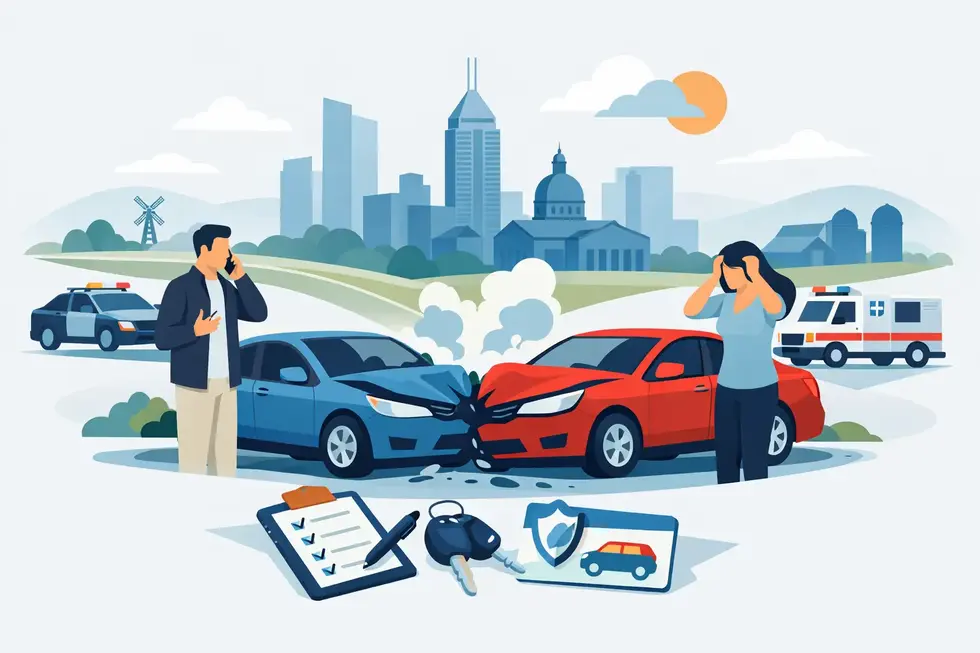
A crash can turn an ordinary drive on I-465, Washington Street, or a rural Indiana highway into a fight over your health, your car, and your financial future. If you are asking what after car accident Indiana, the first hours matter. What you say, what you photograph, whether you seek treatment, and whether you let an insurer control the story can all affect your ability to recover.
You do not need to solve every legal issue at the roadside. You do need to protect yourself, get help, and avoid mistakes that give the person who hurt you or their insurance company an advantage.
What to Do After a Car Accident in Indiana
Get to safety and call 911 when appropriate
If you can move safely, get out of traffic and turn on your hazard lights. Check yourself and others for injuries. Call 911 if anyone is hurt, the crash has blocked traffic, a driver may be intoxicated, there is a hit-and-run, or the vehicles are too damaged to move safely.
Do not assume you are uninjured because adrenaline is masking the pain. Neck, back, shoulder, head, and internal injuries can become clear hours or days later. If you have chest pain, trouble breathing, confusion, numbness, severe pain, or any sign of a head injury, get emergency care immediately.
Indiana drivers are generally required to stop after a collision involving injury, death, or property damage. Leaving the scene can create criminal exposure and make an already difficult situation far worse. Stay calm, remain at the scene unless medical personnel direct otherwise, and cooperate with emergency responders.
Exchange information, but do not argue the case
Get the other driver's name, contact information, driver's license number, insurance information, license plate number, and vehicle description. If there are passengers, get their names and contact information too. Witnesses can be critical when drivers give conflicting versions of what happened, so ask independent witnesses for their contact information before they leave.
Keep the conversation short and factual. Do not apologize, speculate about speed or fault, or say you are fine when you do not know the full extent of your injuries. A simple statement such as, “I need to be checked out,” is enough. Even a polite apology can later be twisted into an admission by an insurance adjuster.
If law enforcement responds, give an accurate account of what you saw and experienced. Do not guess. If you did not see a traffic light or cannot estimate speed, say so. Facts are stronger than assumptions.
Document the scene before the evidence disappears
Photographs and video can preserve evidence that will be gone by the time an insurance company starts asking questions. Take wide shots showing the intersection, lanes, traffic signs, signals, weather, debris, skid marks, and the position of the vehicles. Then take close photographs of vehicle damage, airbag deployment, broken glass, injuries, and anything inside the other vehicle that may matter.
Save dash-camera footage immediately. Ask nearby businesses or homes whether cameras may have captured the collision, but do not delay. Many systems automatically record over video within days. Write down what happened while it is fresh: where you were coming from, where you were going, the sequence of events, statements made by the other driver, and the names of officers or responders.
Your vehicle is evidence, too. Do not authorize repairs, disposal, or salvage until the damage has been thoroughly documented. In a serious collision, the physical condition of the vehicle can help establish the force of impact and how the crash occurred.
Medical Care Is Not Optional Evidence
Some people avoid treatment because they do not have health insurance, cannot miss work, or hope the pain will pass. Those concerns are real. But delaying care can endanger your health and give an insurer an opening to argue that the crash did not cause your injuries.
See a qualified medical professional as soon as you can. Follow through with recommended appointments, physical therapy, imaging, prescriptions, and referrals. Tell your providers every symptom, including headaches, dizziness, anxiety, sleep problems, tingling, and pain that comes and goes. Medical records are not just paperwork. They are part of the proof of what this crash took from you.
Keep copies of medical bills, discharge instructions, prescription receipts, mileage to appointments, and records of missed work. If an injury prevents you from performing household tasks or caring for your children, make a note of that as well. The losses from a wreck are often much larger than the first emergency-room bill.
Report the Crash and Protect Your Insurance Position
Report the collision to your own insurance company promptly, but be careful about recorded statements. Your policy may require cooperation, and your insurer may be the source of medical-payments coverage, uninsured motorist coverage, or underinsured motorist coverage. Still, cooperation does not mean you should speculate, minimize injuries, or accept blame.
The other driver's insurance company may call quickly, sometimes before you have seen a doctor. Their adjuster may sound helpful. Their job, however, is to limit what the company pays. You are not required to give the other side a recorded statement, sign a broad medical release, or accept an early settlement offer before you understand your injuries and losses.
An early offer may cover a few immediate bills while leaving you with no recourse for future treatment, lost income, pain, or permanent limitations. Once you sign a release, the case is usually over. A settlement can make sense in some situations, but it should be a fully informed decision, not a decision made while you are medicated, frightened, or waiting for test results.
Indiana Fault Rules Can Change the Fight
Indiana generally uses a modified comparative fault system. In plain English, your recovery may be reduced by your percentage of fault. If you are found more than 50% at fault, you may be barred from recovering damages from the other party.
That rule is exactly why fault arguments matter. The other driver may claim you were speeding, distracted, following too closely, or failed to yield. An insurer may try to use a partial-fault argument to reduce a legitimate claim. Do not let a casual comment at the scene become the final word on responsibility.
There are also deadlines. Many Indiana personal injury claims have a two-year statute of limitations, but the details can change depending on the facts and the parties involved. Claims involving a city, county, or state agency can carry much shorter notice requirements. A crash involving a government vehicle, a commercial truck, a rideshare driver, or a death requires prompt legal attention because different rules and evidence issues may apply.
When You Should Call a Car Accident Lawyer
You should strongly consider speaking with counsel if you suffered an injury, missed work, face significant vehicle damage, believe the other driver was drunk or distracted, or are being blamed for a crash you did not cause. Legal help becomes even more urgent after a fatal collision, hit-and-run, commercial-vehicle wreck, uninsured-driver crash, or collision involving police or a government vehicle.
A serious injury claim is not just a stack of bills. It may involve investigating the collision, securing video, reviewing the police report, identifying every insurance policy, documenting lost wages, and preparing to fight when an insurer refuses to deal fairly. The Law Office of Mark Nicholson represents injured people across Indiana who refuse to let someone get away with hurting them and then minimizing the damage.
Do not wait for an insurance company to decide what your case is worth. Preserve the evidence, get medical care, keep your records, and get direct legal advice before you sign away your rights. The steps you take now can protect your health and put you in a stronger position to demand accountability later.


Comments
There are no comments for this post. Be the first and Add your Comment below.
Leave a Comment