
The Surveillance State Just Came Home to Indianapolis
There is a breaking story out of Indianapolis that should concern every person who drives a car, owns a vehicle, visits a neighborhood, or simply expects the government to respect personal privacy.
According to WTHR's report, the Indianapolis Metropolitan Police Department announced on Thursday, August 13, 2026, that an unnamed officer was suspended and recommended for termination after allegedly using automated license plate readers, commonly called ALPRs or Flock cameras, for “personal reasons.”
That officer has not been publicly identified, and administrative and criminal investigations remain ongoing. Those facts matter. But the larger issue matters even more:
Indianapolis police technology was allegedly used to track people for a purpose unrelated to legitimate law enforcement.
That is not just a policy violation. It is a warning about what happens when the government builds a surveillance system capable of recording the movements of ordinary citizens.
What happened inside IMPD?
IMPD says it learned on August 6 that the officer was using ALPR technology for personal reasons. The department says the officer was immediately:
- Placed on administrative duty;
- Stripped of police powers;
- Denied access to the ALPR system;
- Relieved of department-issued equipment, including a computer; and
- Placed under administrative and criminal investigation.
Chief Tanya Terry suspended the officer and recommended termination based on facts gathered during the early stages of the administrative investigation.
The department also issued a statement saying that technology itself is not the problem: misuse is: and that public trust is the foundation of effective policing.
I agree with one part of that statement: Misuse is a serious problem.
But I am not willing to dismiss this as merely a “one bad apple” situation. The question is not only whether one officer improperly accessed the system. The question is whether the system made that access too easy, whether anyone was monitoring it, how long the information was retained, and whether similar misuse has gone undetected.
A suspension after the fact is not the same as prevention.
What are ALPR and Flock cameras?
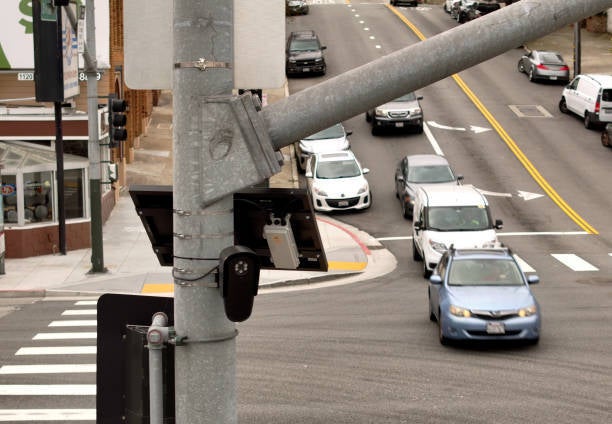
Automated license plate readers use cameras and software to capture images of passing vehicles. The system can record information such as:
- A license plate number;
- The vehicle's make, model, and color;
- The time and date;
- The location of the camera; and
- Sometimes additional vehicle characteristics.
Flock Safety is one company that provides this technology. Flock-style systems can connect data from cameras across cities, counties, and jurisdictions. That means police may not be limited to seeing where a vehicle is today. Depending on agency policies and data-sharing arrangements, investigators may be able to search historical records and identify where a vehicle appeared days or weeks earlier.
The camera may not know your name automatically. But a record of your vehicle's movements can still create a detailed map of your life: where you work, where you worship, which doctor you visit, who you meet, and where you spend your time.
And these systems do not scan only people suspected of crimes. They scan everybody who passes the camera.
This is not just a California or Texas problem
The national controversy over Flock and ALPR systems has grown rapidly. Reporting summarized by Tech Brew states that at least 50 police officers have been charged with or accused of using license plate readers for unauthorized purposes, including stalking former romantic partners. The report says 46 of those cases involved Flock's system.
Flock CEO Garrett Langley has acknowledged that abuse is a problem. Reporting has also described the system processing approximately 20 billion plate scans every month.
The company points to cases solved and missing people located. Law enforcement points to stolen vehicles, endangered individuals, and serious crimes. Those are legitimate public-safety purposes.
But a massive system does not become safe simply because it sometimes helps police solve crimes. A system capable of billions of scans can also cause billions of privacy concerns if access, retention, sharing, and oversight are not tightly controlled.
And now, that controversy has come home to Indianapolis.
This is not something happening only in California. It is not something happening only in Texas. It is an Indianapolis problem involving an Indianapolis police officer and surveillance technology operating in our communities.
“Personal reasons” should set off every alarm
When a police officer runs a license plate for personal reasons, we need to know what that means.
Was the officer tracking a former partner? A family member? A neighbor? Someone involved in a personal dispute? Was the information shared with another person? Was the system used to locate someone's home, workplace, or regular destinations?
The public deserves answers: but those answers must come through a legitimate investigation that protects due process and does not compromise the criminal inquiry.
The concern is also broader than one officer's conduct. If an officer can access ALPR information for personal reasons, what other searches have occurred? Who reviewed the officer's activity? Were there alerts? Are searches automatically logged? How often are those logs audited by someone independent of the officers using the system?
A policy that says “do not misuse the database” is not enough. Powerful surveillance tools require meaningful safeguards, real-time restrictions, audit trails, short retention periods, and consequences that are actually enforced.
Otherwise, the system becomes a temptation sitting inside a police computer.
What does Indiana law say about surveillance?
The Fourth Amendment to the United States Constitution protects people against unreasonable searches and seizures. It does not mean every observation of a license plate on a public road automatically requires a warrant. Police can generally see a plate that is exposed to public view.
But an ALPR network raises a different question from a single officer looking at a single plate.
There is a constitutional difference between briefly observing a vehicle in public and creating a searchable historical record of thousands of movements over time. The more data collected, retained, connected, and used to reconstruct a person's life, the stronger the privacy and constitutional concerns become.
Indiana also has an independent protection under Article 1, Section 11 of the Indiana Constitution, which protects people against unreasonable searches and seizures. In Litchfield v. State, 824 N.E.2d 356 (Ind. 2005), the Indiana Supreme Court explained that reasonableness depends on balancing:
- The degree of concern, suspicion, or knowledge that a violation occurred;
- The degree of intrusion imposed on a citizen's ordinary activities; and
- The extent of law-enforcement needs.
That test is important for ALPR cases. Police may have a legitimate need to locate a stolen vehicle or identify a dangerous criminal suspect. But that need must be weighed against the intrusion involved in collecting and searching the movements of people who are not suspected of anything.
Indiana law also addresses search warrants through Indiana Code § 35-33-5-2. That statute requires a warrant affidavit to establish probable cause and particularly describe the place, person, or things connected to the search. If ALPR data is used to support a warrant, investigators and prosecutors may face questions about how the data was obtained, how reliable it is, whether the information was stale, and whether the affidavit fairly disclosed the limits or possible errors in the technology.
A plate-reader hit is not the same thing as proof of guilt. Technology can produce false positives, incorrect plate readings, or an innocent explanation for a vehicle's location.
I have seen how much these systems can matter
I understand the investigative value of ALPR evidence because I handled a Hamilton County case last year involving an alleged jewelry-store robbery of approximately $1 million.
In that case, license-plate-reader information was used to help identify a vehicle and connect it to the investigation. That kind of technology can be valuable evidence. But valuable evidence still has to be obtained, preserved, interpreted, and presented lawfully.
The existence of a camera does not eliminate the need for police work. It does not eliminate the presumption of innocence. And it does not give officers unlimited authority to search through a person's movements.
Every piece of digital evidence needs to be challenged and examined:
- Who collected it?
- Who accessed it?
- What was the purpose of the search?
- Was the search authorized?
- Was the information accurate?
- How long was it retained?
- Was it shared with another agency?
- Does it actually connect the accused person to a crime?
That is what aggressive criminal defense requires. It means following the evidence instead of accepting a government database as infallible.
What should Indianapolis do now?
The IMPD investigation should be thorough, independent, and transparent to the greatest extent permitted by law. Indianapolis residents should demand clear answers about:
- How many ALPR cameras IMPD operates or can access;
- Which officers and employees can search the system;
- Whether every query is logged and audited;
- How long routine data is retained;
- When information may be shared with other agencies;
- What approval is required for historical searches;
- How improper searches are reported; and
- What remedies are available to people who were unlawfully tracked.
Public safety does not mean unlimited surveillance. Police need tools to investigate serious crimes, but those tools must remain within constitutional boundaries. There is a website called Deflock to locate Flock cameras near you.
If you believe police or another government agency used surveillance technology to target, stalk, harass, or investigate you without a legitimate basis, preserve every document, message, notice, and interaction you have. Do not assume the matter is too complicated to challenge. The data may be the key to proving what happened.
At the Law Office of Mark Nicholson, I represent people facing criminal charges and people whose civil rights have been violated. I prepare cases thoroughly, fight aggressively, and hold the government to its burden. I am also available for consultations 24/7 because when the state's machinery turns on you, waiting is not a strategy.
I am Mark Nicholson: the Battery Man: and I believe citizens need a fighter when police power crosses the line.


Comments
There are no comments for this post. Be the first and Add your Comment below.
Leave a Comment