

You're sitting at home after a police encounter, replaying the same few seconds in your mind. Maybe an officer forced you to the ground after you had already stopped moving. Maybe you were handcuffed when the strikes continued. Maybe you suffered an injury during a traffic stop, arrest, or jail intake, but you're unsure whether the law sees what happened as misconduct or as permitted police work. That uncertainty is common, but waiting for the answer can cost you evidence.
An excessive force lawsuit isn't based only on how frightening, painful, or humiliating the encounter felt. The case turns on specific facts, preserved quickly, and connected to the constitutional standard that governs police force. Indiana residents should document the incident immediately, expect qualified immunity to become a central fight, and evaluate settlement expectations realistically.
Recognizing Excessive Force in a Police Encounter
Consider two versions of the same arrest. In the first, an officer approaches a person suspected of a serious violent offense. The person reaches toward a weapon, ignores commands, and tries to escape. The officer uses force to stop the immediate danger. In the second, the person is suspected of a minor offense, keeps both hands visible, follows instructions, and is already restrained when the officer applies additional force. The injuries might look similar, but the legal analysis can be very different.
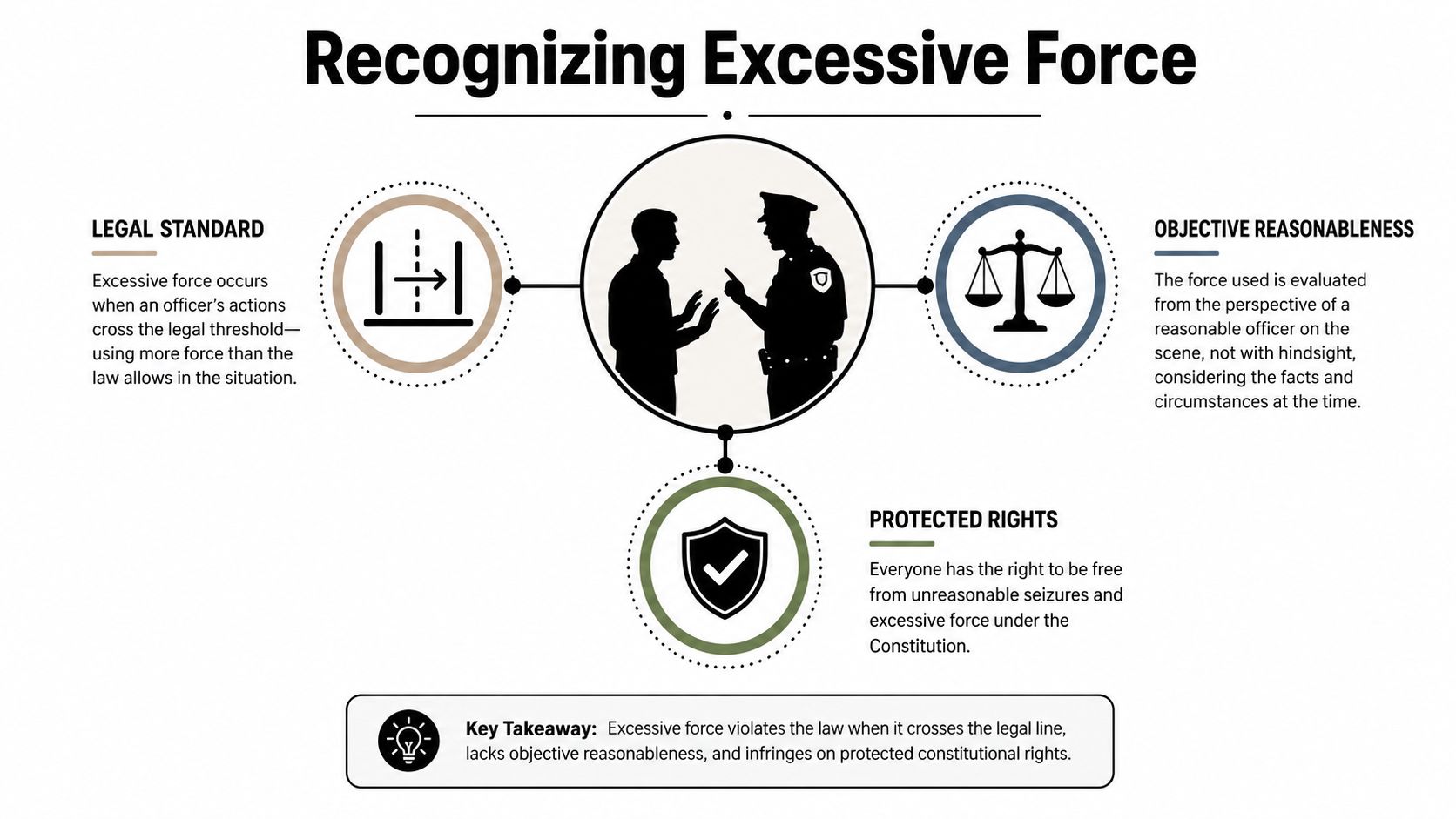
The controlling question is whether the officer's actions were objectively reasonable under the Fourth Amendment. In Graham v. Connor (1989), the U.S. Supreme Court established objective reasonableness as the standard for claims involving force during an arrest or investigatory stop, replacing broader due-process theories in many cases and shaping the nationwide analysis of split-second police decisions. The historical development of that standard is summarized in this overview of excessive-force and police-brutality cases.
The three facts courts examine
Courts generally assess the circumstances through three central considerations:
- Severity of the suspected offense: Force used during an investigation of a serious, dangerous offense may receive more legal justification than force used over a minor violation.
- Immediate threat: The officer's perception of danger matters. Courts examine what the person was doing, where their hands were, whether a weapon was visible, and how quickly the situation was unfolding.
- Active resistance or flight: A person who is actively fighting or fleeing presents a different situation from someone who is compliant, passively resisting, or already secured.
Those factors don't operate like a mathematical formula. Officers can't use unlimited force just because an arrest involves a serious allegation, and a person's resistance doesn't automatically justify every later action. The timing matters. Force that may have been reasonable before handcuffing can become unreasonable after the person is controlled.
Practical rule: Identify the exact moment when the threat ended, resistance stopped, or compliance began. That point often matters more than the general description of the encounter.
A painful interaction isn't automatically unconstitutional. Officers may lawfully use force to make an arrest, protect themselves or others, prevent escape, or control resistance. The stronger claim usually shows a mismatch between the force used and the actual circumstances, supported by video, medical documentation, witness accounts, or other objective evidence. For an accessible explanation of the distinction, review what police brutality or excessive force means.
Federal and Indiana Legal Foundations for Your Claim
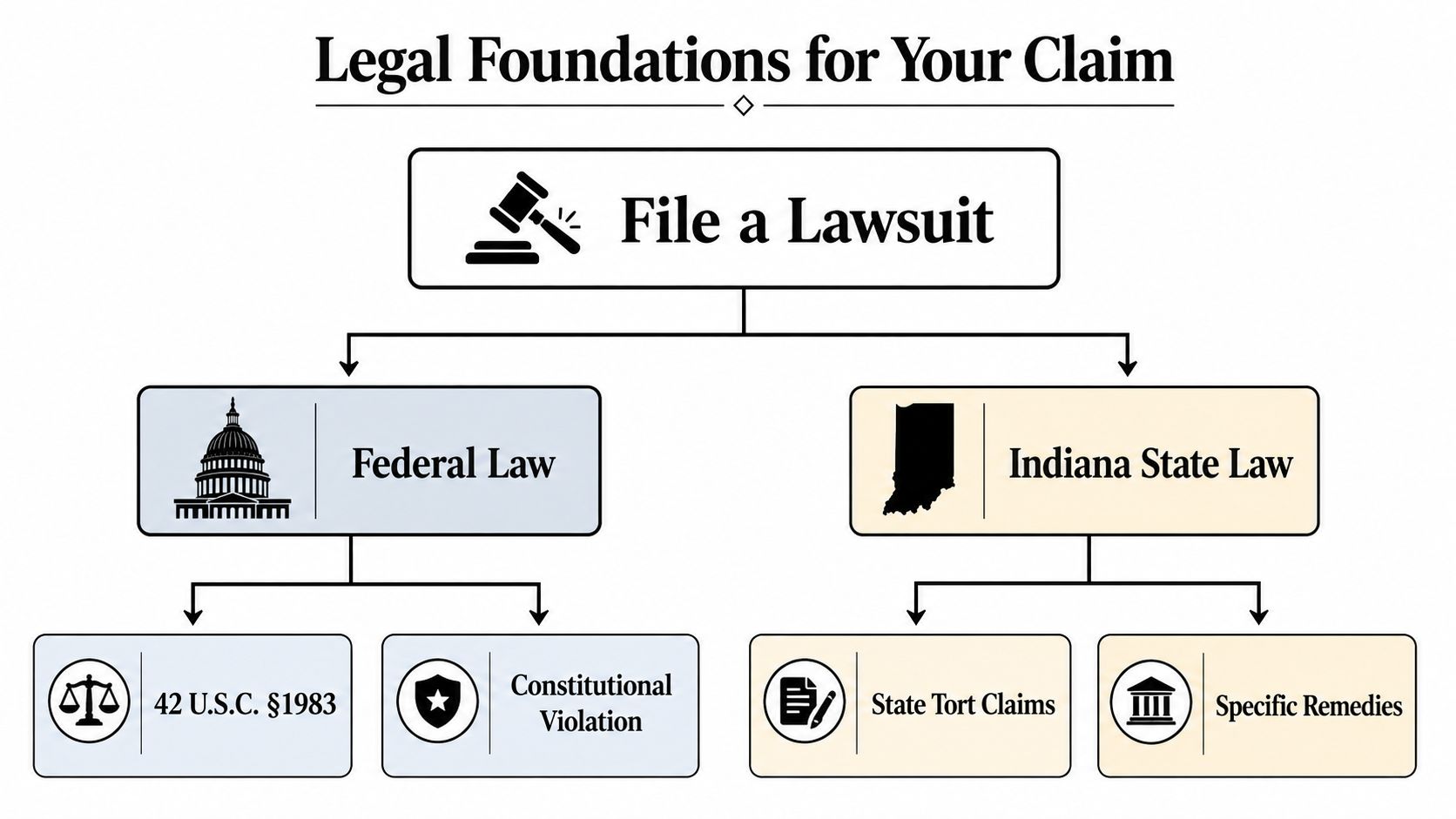
If an Indiana officer throws you against a wall after you are restrained, the legal question is not whether the encounter felt harsh. The court asks whether the force was objectively unreasonable under the Fourth Amendment, based on the facts known at the time. A federal claim usually proceeds under 42 U.S.C. §1983, which provides a way to sue a person acting under government authority for violating constitutional rights.
In Monroe v. Pape (1961), the Supreme Court confirmed that people could bring §1983 claims for constitutional violations even when the conduct violated official policy or occurred outside it. Later, Graham v. Connor established the objective-reasonableness test for force used during arrests and investigatory stops. Together, those decisions form the backbone of modern excessive-force litigation. This account of the framework's historical milestones provides additional background.
Federal claims and state claims serve different purposes
A federal §1983 claim targets the constitutional violation. Indiana tort claims may address related conduct through battery, false arrest, or other state-law theories. The facts may overlap, but the legal tests, defenses, and filing requirements do not.
A state battery claim may ask whether an officer intentionally made harmful or offensive contact without legal justification. The federal claim asks whether the force was unreasonable under the Fourth Amendment. One theory can survive even if another fails, so your attorney should evaluate both instead of treating one label as the whole case.
Indiana's governmental-claim procedures create additional risks for claims against public entities. Notice requirements, governmental immunities, and defendant-specific rules can defeat a state claim before the court considers the underlying force. Do not assume that filing a §1983 claim satisfies every Indiana requirement.
Choosing defendants requires precision
Naming every officer, department, and government entity can weaken the case. An individual-officer claim focuses on that officer's conduct and may face qualified immunity. A claim against a city, county, or police department requires evidence that a policy, practice, or legally actionable failure caused the constitutional injury. Employment alone does not establish entity liability.
The proper court depends on the claims and defendants. Federal claims commonly proceed in federal court. Indiana claims may be filed in state court or with federal claims when supplemental jurisdiction permits. That choice affects discovery, motion practice, immunity defenses, and settlement pressure. Before filing, counsel should identify each defendant, match each claim to its required elements, and preserve the facts supporting the theory.
Evidence and Documentation That Build a Winning Case
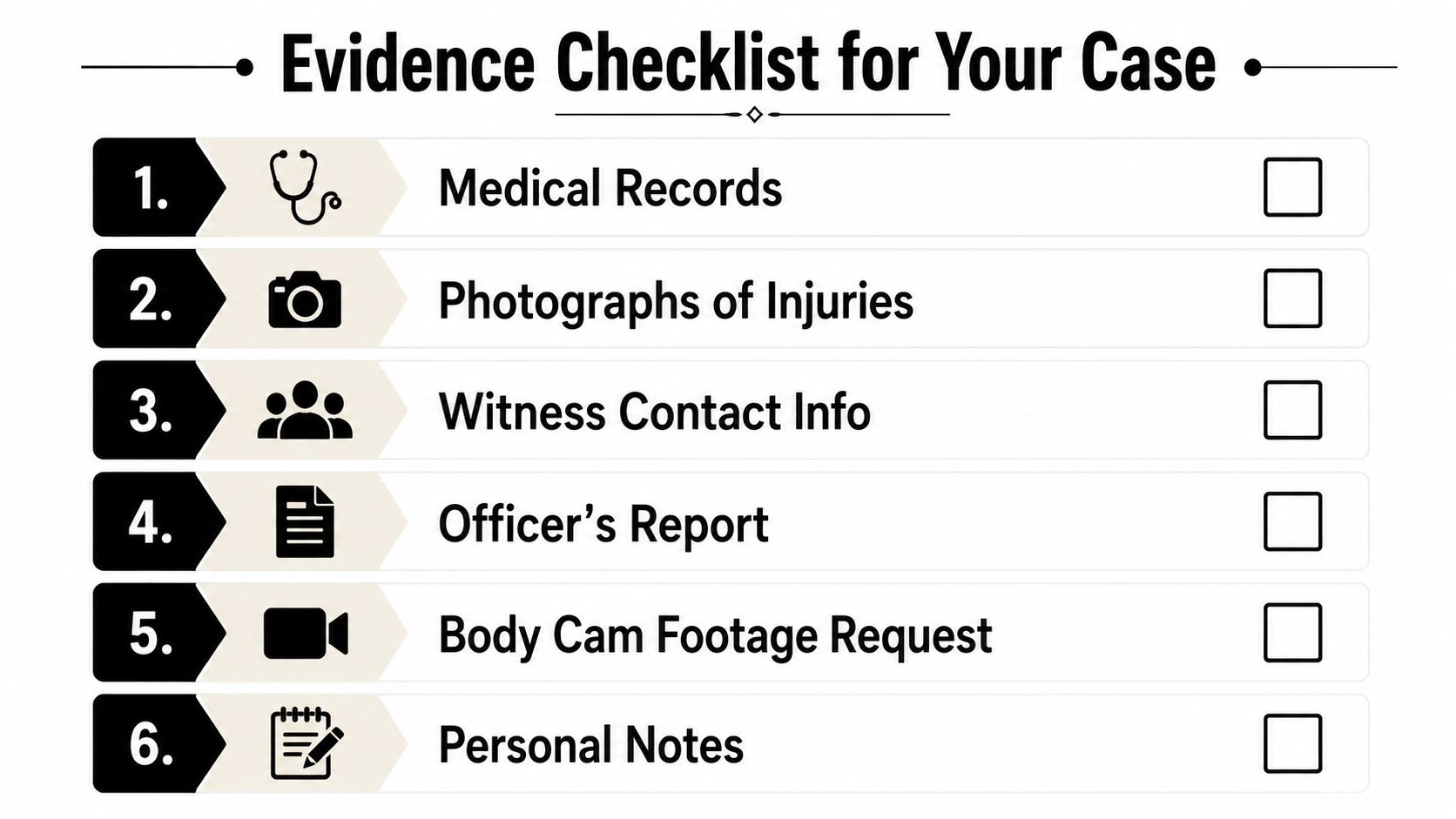
The first 72 hours can determine whether an excessive-force lawsuit has a usable factual record. Your memory matters, but video, medical records, dispatch information, photographs, and witness accounts usually provide the stronger foundation because they help reconstruct what happened in sequence.
Start with your health. Seek medical evaluation even if the injury initially seems manageable. Tell the clinician exactly what happened, identify every area that hurts, and follow the recommended treatment. Medical records can connect the officer's action to the injury, show when symptoms appeared, and document whether the condition affected work, sleep, movement, or daily activities.
Build the record before it changes
Use a phone or camera to photograph swelling, bruising, cuts, torn clothing, and visible marks. Take photographs from useful distances and in good lighting. Preserve the original files rather than relying only on edited or compressed versions.
Write a detailed timeline while the sequence remains fresh. Record commands, your responses, the officer's movements, the location of each person, when handcuffs were applied, when force began and stopped, and the names or descriptions of witnesses. Don't fill gaps with guesses. Mark uncertainty clearly.
- Preserve physical evidence: Keep clothing, broken glasses, medical devices, and other damaged property in a safe place.
- Identify witnesses: Obtain names and contact information, and ask each witness to write down what they personally observed.
- Request records: Ask for incident reports, dispatch logs, body-camera footage, dashcam footage, and related records through appropriate Indiana public-records procedures.
- Document complaints: If you file an internal complaint, retain the submission, confirmation, reference number, and all correspondence.
- Protect digital material: Save copies of videos, photographs, messages, and social-media posts in more than one secure location.
Connect force to harm
A viable claim needs more than proof that force occurred. It needs a clear causation chain: what the officer did, why that action was unreasonable under the circumstances, and what documented harm followed. A medical record that says only “pain after arrest” may be less useful than a record describing the mechanism of injury and the treatment required.
An empirical study of over 500 §1983 excessive-force cases found that cases become stronger when evidence precisely identifies timing, compliance, distance, posture, and weapon deployment, improving the ability to survive summary judgment and challenge immunity. The study is available through research on factual specificity in excessive-force litigation. For practical guidance on preserving records and making a complaint, see how to file a police-misconduct complaint effectively.
How Qualified Immunity Blocks Many Excessive Force Claims
Qualified immunity is where many seemingly compelling cases fail. The public may see an injury, a disturbing video, or conduct that appears plainly abusive. The court still asks a narrower legal question: did the officer violate the Constitution, and did the officer violate clearly established law at the time of the incident?
That second question creates the practical barrier. A plaintiff generally must identify precedent with sufficiently similar facts to show that a reasonable officer would have understood the precise conduct to be unlawful. A broad rule against unreasonable force may not be enough. Courts often compare the weapon involved, the level of threat, the person's resistance, the officer's commands, the distance between the people, and the conditions at the scene.
Why injury alone isn't enough
A serious injury proves that something harmful happened. It doesn't automatically prove that the officer's conduct violated clearly established law. A person can suffer a fracture during a lawful effort to control dangerous resistance, while a person can also suffer a less visible injury from force used after compliance that may support a constitutional claim.
The legal comparison must focus on the conduct, not just the result. A successful complaint should preserve the facts that allow counsel to locate close precedent and explain why the officer had fair notice.
The question isn't only whether the force looked wrong. It's whether existing law made this specific use of force unlawful in this specific situation.
An empirical analysis of Supreme Court excessive-force decisions found that officers received qualified immunity in 10 of 13 cases studied, demonstrating how frequently the clearly-established requirement acts as a high-friction gate. The underlying analysis is available in research on qualified immunity and excessive-force decisions.
Qualified immunity can arise early through motions to dismiss or summary judgment. That means a case may end before a jury evaluates the officer's conduct. Counsel must therefore frame the evidence around concrete factual disputes and precedent, rather than relying on general allegations that the officer acted brutally.
For a plain-language discussion of the doctrine and its effect on civil-rights claims, review what qualified immunity means and whether it should be reformed. The attorney you choose should be comfortable researching fact-specific appellate decisions, challenging the immunity defense, and preserving the record for review.
Realistic Settlement Data and Available Damages
People often ask what an excessive-force lawsuit is worth. The honest answer starts with the probability of receiving anything. A 2026 analysis of 260 police-civil claims found that 66% of claimants received no settlement. Among paid claims, the median settlement was $1,400.68, and 75% settled for $514.33 or less. The same dataset recorded a maximum payout of $3,750,050, showing how sharply routine outcomes can differ from exceptional resolutions. See the published analysis of police-civil settlement outcomes.
| Outcome Category | Percentage or Value | What It Means |
|---|---|---|
|
No settlement |
66% |
Most claimants in the analyzed dataset received nothing. |
|
Median paid settlement |
$1,400.68 |
The midpoint among claims that received payment was modest. |
|
Claims settling at or below this level |
$514.33 or less for 75% of claims |
Many paid claims resolved for limited amounts. |
|
Maximum recorded payout |
$3,750,050 |
Rare cases can produce dramatically higher resolutions. |
Damages depend on proof, not outrage
Compensatory damages may address medical expenses, lost income, physical pain, emotional distress, and other proven losses. The value depends on the records, the injury's duration, the impact on work and daily life, and the strength of the causation evidence.
Punitive damages may be available against an individual officer when the conduct meets the required level of intentional or reckless disregard for federally protected rights. They aren't automatic, and they require a stronger showing than ordinary negligence or a mistake in judgment.
A case may also seek injunctive or declaratory relief, although the availability and practical value of those remedies depend on the plaintiff's circumstances and the defendant. Policy pressure can arise through litigation and settlement, but a settlement doesn't necessarily establish that the city or officer violated the Constitution.
Municipal claims can create broader financial and operational consequences. For example, New York City reported 6,082 FY 2025 “Police Action” claims and more than $113 million in settlements, a category that includes excessive or unnecessary force allegations and represented the city's largest source of tort claims, according to the New York City Comptroller's report. That pattern illustrates why governments may negotiate settlements even when they don't admit constitutional liability.
Indiana Statute of Limitations and Procedural Deadlines
Deadlines can destroy a valid claim before a court reaches the facts. Indiana residents should contact a civil-rights attorney promptly, because federal and state theories may carry different procedural requirements and a public defendant may require notice before a lawsuit can proceed.
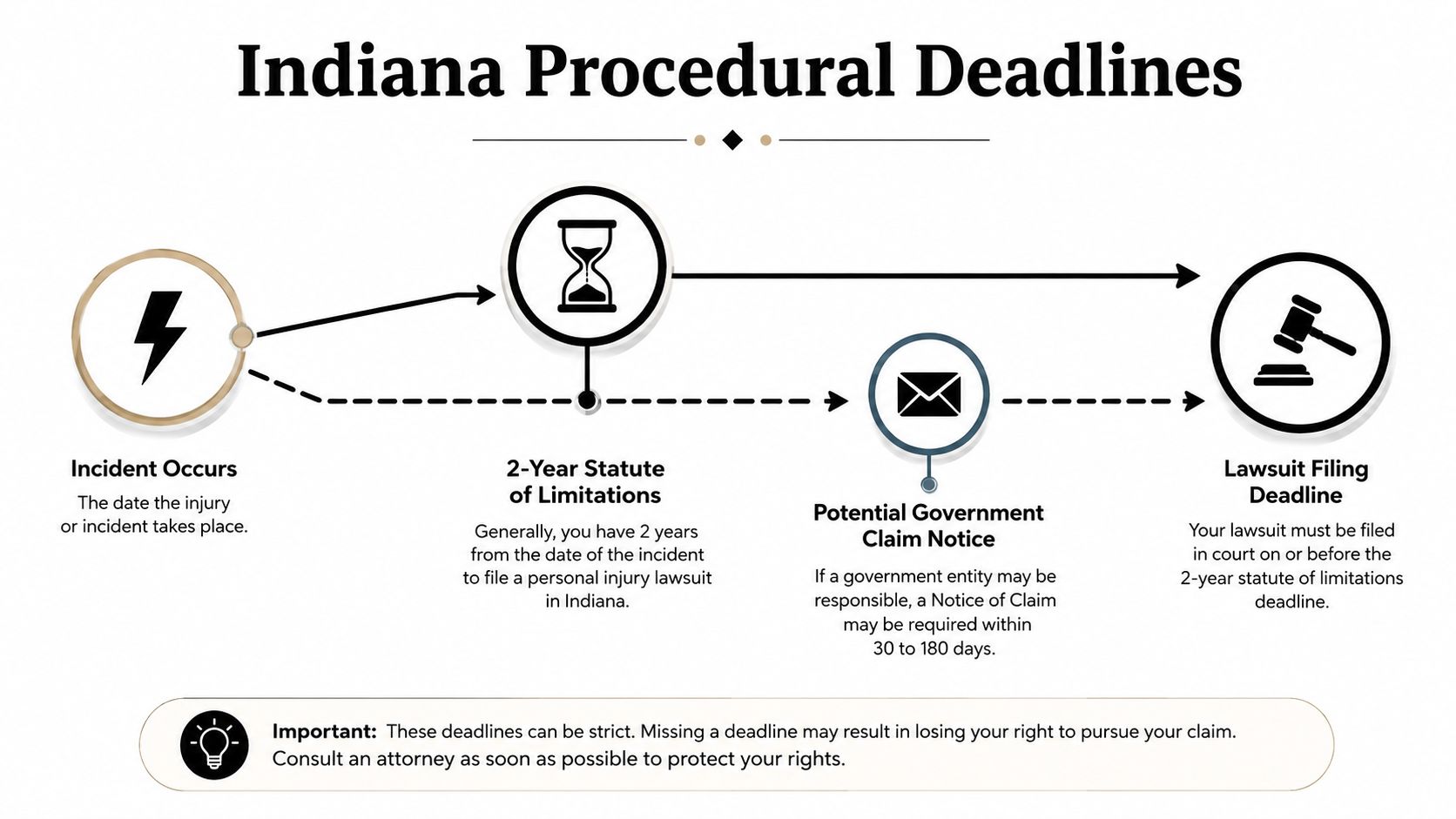
For a federal §1983 claim arising in Indiana, lawyers generally analyze the state's personal-injury limitations period. The commonly used period is two years, but the precise calculation can depend on the claim, the defendant, accrual rules, and tolling issues. Don't treat a general deadline as permission to wait.
Government notice creates a separate risk
Indiana state-law claims against governmental entities may implicate the Indiana Tort Claims Act. Notice requirements can apply before filing suit, and the deadline may depend on the government defendant and the nature of the claim. The infographic's 30-to-180-day range reflects that potential variation, not a universal deadline for every case.
That distinction matters. A person may preserve a federal claim yet lose a state claim by missing a notice requirement. The right approach is to identify every possible defendant immediately, determine whether each is a city, county, town, state agency, or individual, and calculate the applicable notice and filing dates separately.
Expect a long procedural fight
A typical case may move from investigation and filing into service, motions, written discovery, depositions, expert review, summary judgment, settlement negotiations, and trial preparation. Qualified immunity can produce an early motion, while disputes over video, medical causation, municipal policy, or credibility can extend the case.
Tolling doctrines sometimes affect a deadline, but they're limited and fact-specific. Never assume that an arrest, criminal case, medical treatment, internal complaint, or informal conversation with an agency automatically pauses the civil deadline.
Do this immediately: Write down the incident date, every medical visit, every government contact, and every piece of evidence you know exists. Give that timeline to counsel before any deadline calculation begins.
Your Next Steps and When to Contact an Indiana Civil Rights Attorney
If force was used against you, start with preservation rather than confrontation. Obtain medical care, photograph injuries, preserve clothing, identify witnesses, write a detailed timeline, and secure copies of every video, message, report, and medical record. Don't post a detailed account online, argue with officers or the department, or delete messages that may later establish timing.
An attorney should evaluate four issues early:
- The force sequence: What happened immediately before, during, and after each use of force?
- Objective evidence: Does video, dispatch data, medical documentation, or an independent witness support your account?
- Legal fit: Does the conduct violate the Fourth Amendment, and do closely comparable decisions address the qualified-immunity defense?
- Defendants and deadlines: Which officer or entity can legally be sued, and what notice or limitations periods apply?
Prepare for an initial consultation by bringing photographs, discharge papers, medical bills, employment records, witness information, police paperwork, and a written chronology. Tell the lawyer facts that hurt your case as well as facts that help it. Credibility problems become more damaging when counsel discovers them late.
Ask whether the attorney handles §1983 litigation, qualified-immunity motions, Indiana governmental claims, body-camera preservation, and federal discovery. Ask how the firm evaluates municipal liability and what work it will do before deciding whether to file. A general personal-injury approach may not address the legal barriers that control an excessive-force case.
The Law Office of Mark Nicholson is an Indianapolis-based Indiana firm that handles civil-rights matters, including excessive use of force by law enforcement. Its published client services include 24/7 consultation availability and secure case-status tracking, which may help prospective clients organize communication during a complex claim.
The Law Office of Mark Nicholson can evaluate the force sequence, preserve evidence, analyze qualified immunity, and pursue federal or Indiana claims when the facts support them. Visit Law Office of Mark Nicholson to request a consultation about your Indiana excessive-force lawsuit and bring your incident timeline and records to the conversation.


Comments
There are no comments for this post. Be the first and Add your Comment below.
Leave a Comment